Multiplication Ancient and Modern
Henry Higuera
Download PDF
I’ll start by explicating my title. In my opinion, the word "multiplication" has had five or so meanings in the past 2500 years, but they have been confused and mashed together.[1] This has had unfortunate results which include skull- splitting, intimidation, discouragement, demoralization and apathy, as people attempt to understand how these five are "really the same operation," as they are often told to think they are—when in fact in important respects they are not. Plus, this confusion prevents people from seeing what the operations truly have in common—for they do have important things in common—and also how the different kinds go beyond each other and can do more and different things—which in itself is a beautiful story and a worthwhile object of reflection. I am going to try and dispel some mystery and introduce what I hope is pleasing clarity.
Now, this lecture is not about really modern “multiplication,” including attempts like Dedekind’s to define multiplication of real numbers as part of a broader effort to refound calculus on the basis of the real numbers.[2] My lecture stops short of Dedekind. Rather, what I’m trying to do, in a way, is to clarify the existing situation which Dedekind faced in the 1850’s when he started trying to teach kids calculus. So, I’m looking at the math we do here at St. John’s, before Dedekind, in the spirit in which it was originally done, clarifying unspoken or forgotten distinctions.[3] I am emphasizing the continuity in this process—for there was both revolutionary change and continuity throughout. Thus, until my conclusion I am saying very little about number and the revolution in the conceptualization of number. Indeed, I am going to talk a lot about "multiplying magnitudes," "multiplying lines" and the like, since that is the way our authors talked. They, i.e. the pre-Dedekind math we do, tend to mash together number and magnitude. I am going to follow them in this, and in a way try to defend that: for clarity can still be achieved if one reads them carefully.
I am trying to speak in the spirit of Jacob Klein: I am trying to be self- reflexive about the concepts we use, to get past "sedimented meaning," where you use a concept well enough for practical purposes without ever examining what it means. Also, this is in the spirit of St. John’s as a whole, and our understanding of liberal education as concerned with the elements of learning. I am striving for clarity about some elements of the math we all think we know. The thinkers we'll look at provide occasions for examining what we thought we knew; the history as such—in terms of who was the first person to think x, y, or z—is not our main interest.
This lecture will be in six parts, one on each kind of multiplication plus a concluding section. Let me list my five kinds in order. They are: repeated addition as multiplication, or Euclidean Multiplication; compounding ratios as multiplication, or what we'll call Vietean Multiplication; finding a fourth proportional as multiplication, or Cartesian Multiplication; multiplying by –1, or High School Multiplication; and multiplying by i, or Engineering-School Multiplication.
1. Euclidean Multiplication
I won't spend a lot of time on this. Euclidean Multiplication is repeated addition, just like you learned in first grade. In Euclid’s formal definition, Def. 15 of Elements Book VII, one number "is added to itself as many times as there are units" in some other number, thus forming a third number. Some handy terminology: The number which is added to itself is called the "multiplicand," the number which determines how many times that happens is the "multiplier," those two collectively are the "factors," and the result is the "product."
Now it’s also clear in Euclid, from Elements V on, that the multiplicand does not have to be a number: any magnitude which can be added to itself can also be "multiplied." Euclid uses the same word for "multiply" inbooks V and VI, with reference to magnitudes, as he does in book VII, where he defines it formally with respect to numbers. Euclid gives no explicit definition of "multiplication" with respect to magnitudes.
My impression is that he considered this an acceptable, natural generalization of "multiplication" in the strict sense. But he did not consider it to be "multiplication in the strict sense," and therefore did not define it. For example, this wider use of multiplication is not commutative: a line added to itself five times makes sense, but the reverse does not make sense, let alone equaling the former; whereas Euclid proves that multiplication in the strict sense is commutative at Elements VII. 16.
By the "generalization" of an operation I mean something quite specific here: I mean applying more widely, like to other objects, the defining characteristic of an operation—here, repeated addition. Repeated addition has many beautiful properties and two kinds of "division" that can be derived from it. For example, "How many times does 3 go into 12?" is not the same question as "If you divide 12 into 3 equal parts, how many units are in each part?" The answer is indeed always the same number, as Euclid proves at VII. 37–38, but not the same number of things. We must skip over all that in the interests of time. I will just mention that for this multiplication, i.e. including both the stricter and the wider sense, the product is always a magnitude of the same kind as the multiplicand and may or may not be of the same kind as the multiplier. The multiplier must always be a number.
2. "Vietean" Multiplication
Francois Viete (1540-1607) was important in the early development of algebra and—so far as our readings at St. John's are concerned—the first to redefine "multiplication" as compounding ratios.[4] St. John's students encounter him at the end of Sophomore Mathematics, and he figures prominently in Jacob Klein’s book on Greek mathematics and algebra. The work I will be quoting from is from 1591, although the edition I will cite is from 1642 (more on that below).[5]
But first we have to do a brief review of compounding ratios. Euclid never defines it, but there is an implied definition in Elements VI. 23, the one about equiangular parallelograms.
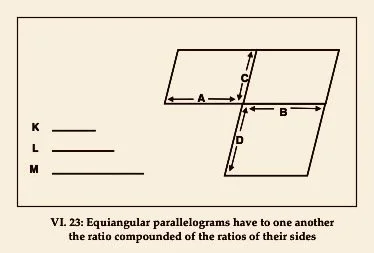
Put somewhat loosely, a compound ratio is this:
If you have two given ratios, A : B and C : D,
and A : B : : K : L and C : D : : L : M ,
then by definition, K is to M in the ratio compounded of A : B and C : D, often written K : M comp. A : B, C : D
or K : M : : A : B comp. C : D.
Does this ring a bell? To compound two given ratios you have to find three magnitudes—here represented by lines—such that the first and second are in the first given ratio and the second and third (i.e., one magnitude is common here) are in the second given ratio. To think about this as an operation, you can think of taking those magnitudes in the first given ratio (K and L), then s-t-r-e-t-c-h-i-n-g the second magnitude L out according to the second given ratio; and then the result of that stretching process is the third magnitude you want, M; and then K is to M in the compounded ratio.
That’s very abstract and general, so let’s take a numerical example—since you can compound number ratios just like any others. Let’s take two ratios, 2 : 3 and 5 : 6, and apply the definition above. We need three magnitudes K, L and M—I’ll be using numbers in particular—that are in the given ratios. For K, let’s pick, oh, 10, and see if we can figure out what L and M have to be.
Well, 2 : 3 :: 10 : 15, so if K is 10, our L has to equal 15.
Then, 5 : 6 :: 15 : 18, so our M must equal 18.
Thus our K, L and M are 10, 15 and 18, respectively and, using K : M,
10 : 18 comp. 2 : 3, 5 : 6.
So we’ve succeed in compounding our given ratios. However, this example shows more than that. If you look again, it shows a striking connection with Euclidean multiplication, for I picked 10 as my K, which equals 2 × 5, i.e. the product of the antecedents of the given ratios, and my M turned out to be 18, which is 3 × 6, i.e. the product of the consequents.
Using the product of the antecedents and consequents like this always works.[6] Euclid proves it at VIII. 5, which states that "plane numbers (i.e. products) have to one another the ratio compounded of the ratios of their sides (i.e. their factors)." So: Euclidean Multiplication provides a handy, no-guesswork computational tool for compounding number ratios.
From this someone might want to conclude that compounding number ratios is the same thing as multiplying pairs of numbers. This would be a big mistake. They are not the same thing: they are not defined the same way; they don’t mean the same thing. "2 × 5" and "3 × 6" don’t tell you why
2 × 5 : 3 × 6 comp. 2 : 3, 5 : 6.
To see that you have to go back to the definition of compound ratio. In general, this is a crucial thing to grasp: a handy computational method can often lead away from the meaning of the thing which is being computed. The method of computation can confuse or distract from the definition of what’s being computed.
One example of a confusion caused by a handy computational method is the arithmetic mean, which is a mean between two extremes such that the differences between it and each extreme are equal. With numbers, or algebraically, there is a way you can compute this mean, and it’s exactly the same computation as the average. Thus, given two terms/extremes, their arithmetic mean always equals their average value. However, the average means something entirely different—it’s the equivalent uniform value of any number of terms, or something to that effect—and should not be conceptually confused with the arithmetic mean.
Now: in order to define "multiplication," Viete denies this very distinction that I’ve just made so much of. Let’s see how this happens. In his Introduction tothe Analytic Art, Viete speaks of "multiplying" one magnitude by another magnitude, and it is clear from the context that neither of them has to be a number. At this point the editor of the 1642 edition, one Van Schooten (a good mathematician in his own right) comments as follows:
The compounding of ratios is effected by the multiplication of the antecedents and the consequents, respectively, as is clear from the things which Euclid shows in the Elements VI. 23 and VIII. 5.[7]
Now, Elements VIII. 5 does indeed prove, as we’ve just mentioned, that Euclidean Multiplication effects the compounding of ratios. But Elements VI. 23 is about constructing equiangular parallelograms and does not mention, or seem to contain, multiplication at all. Still, I believe that Van Schooten’s comment is very astute and that he is quite right in two ways. First, that very construction of the parallelograms does indeed effect the compounding of ratios: that is, it really does result in end results whose ratio is compounded of two given ratios.
Second, Viete, does want to call that very operation "multiplication," and he wants to do so for that very reason. That’s the way he treats all constructing of rectangles out of lines in his algebra: as multiplication.
We are imagining the first great redefinition of "multiplication." From now on, any operation which effects compounding of ratios is to be called "multiplication." To put it more clunkily:
DEFINITION: Multiplication is any operation or process whereby pairs of factors produce products in the ratio compounded of the ratios of those factors.
Symbolically, you could depict it thus:
Definition:
a1 · b1 → p1 and a2 · b2 → p2
IF
p1 : p2 comp. a1 : a2 , b1 : b2 .
This is a genuinely new meaning: it goes farther than what I called "generalization" above. That is, it does not apply the defining characteristic of Euclidean Multiplication to new objects; it is not repeated addition of anything.[8] It applies a property of Euclidean Multiplication to new objects—one having to do with ratios—but not the property which makes it what it is.
But let us accept it for what it is: a new operation, "Vietean Multiplication," distinct from Euclidean Multiplication but closely analogous to it in the way it relates to ratios. (Once again, we are provincially ignoring the strict historical question and naming the multiplication after the author from whom we first encounter it at St. John's.) Having done so, I want to point out that this new operation has five crucial properties, four of which are not possessed by Euclidean Multiplication.
First of all, numbers do not have to be involved, either as "multiplicand" or as "multiplier." They can be involved, however; they are not excluded. Thus Euclidean Multiplication might even be considered, now, as one specific instance of Vietean Multiplication.
Secondly, none of the magnitudes involved have to be commensurable with any of the others.[9]
Thirdly, the antecedents (the a’s above) and the consequents (the b’s above) do have to be magnitudes of the same kind as each other. However, the antecedents do not have to be magnitudes of the same kind as the consequents, although they can be. Nonetheless, if done correctly, the products are always magnitudes of the same kind. Thus Viete has given a meaning to "multiplying an area by a line": to produce a solid. Furthermore, not only can you do this in geometry, but you can also do this in physics: you can, for example, multiply a speed by a time or a mass by a speed. It would be hard to overstate the importance of this for the methods of modern mathematical physics. In the world, in nature, there seem in fact to be a great many processes whereby certain quantifiable factors somehow cooperate or interact to produce results which are in the ratio compounded of the ratios of those factors. All such interactions—all such spontaneous, real-world interactions—can now be called multiplication. "Multiplication" can now refer to things which happen in nature, well beyond the Biblical "being fruitful."
Fourthly: "Division" can easily be defined, as the inverse of multiplication. Viete has given a meaning to "an area divided by a line" or "a weight divided by a volume." Obviously, the importance of this would likewise be hard to overstate.
Fifth and last, Euclidean Multiplication does provide a computational rule for this new operation. It provides an exact one if the factors are commensurable. For example, if two rectangles are as 2 : 3 and two lines are as 5 : 6, then the rectangular solids produced by those lines as heights are as 10 : 18. You can calculate this result by Euclidean Multiplication without bothering with the construction and measurement.
Furthermore, this result is literally true, not a mere analogy. The two solids really do have to one another the same ratio that ten has to eighteen. Even more: if the factors are not commensurable, Euclidean Multiplication can still be used to compute an approximation for the ratio of the products, because the ratios of the given factors can be approximated by number ratios. Finally, recall that in the real world, incommensurability is not a practical problem, since due to the limited sensitivity of measuring instruments there is always a smallest practical or perceptible unit that measures two magnitudes.
Consequently, for all practical purposes Euclidean Multiplication can be regarded as the never-fail computational method for computing compound ratios. I hope you can see the increase in power and scope of applicability that is gained by this redefinition—I think it is rather breathtaking, a real gain that must be balanced against the progressive loss of clarity which came with it.
Here’s one witness to the power of the Vietean redefinition. Isaac Newton typically uses Vietean language in the Principia. Almost invariably he will refer to a rectangle as the product of two lines.[10] He’ll write, for example, "the rectangle PQ × QT," by which he means the Vietean product: the rectangle contained by lines PQ and QT. In a scholium to Lemma X he actually explains joint variation[11] in terms of multiplication ratherthan by explicitly invoking compounded ratios: "If A is said to be as B directly and C directly… the meaning is that A is increased or decreased in the same ratio as B × C…" In the Scholium to the Laws he somewhat apologetically extends the use of this language even further, saying in order to get a certain useful result "body A will have to be multiplied (so to speak) by the chord of the arc TA."[12]
As a final note, there is an additional property which must be mentioned: with Vietean Multiplication, the product is always a magnitude of a different kind than either of the factors. Two lines yield a rectangle, a mass and a speed yield a momentum, and so on. This is a hard-and-fast rule in Viete’s own algebra[13]—and, in fact, it is an extremely important rule to follow even now when you’re working with physics equations. But it is also a limitation or a restriction on its use, and so it will also become relevant in our discussion of the next kind of multiplication, as you will see.
3. Cartesian Multiplication
Let’s move on to our third meaning, finding a fourth proportional. Descartes lays this out in his Géometrie of 1637. The following is how he tells us to multiply a line by a line. This could obviously be extended to any kind of magnitude, as can be seen:
1. Pick a line arbitrarily, at your convenience;
2. Call that line "the unit"—as Descartes says,
"in order to relate [this line] as closely as possible to numbers."
3. Then, given two other lines a and b which you wish to "multiply, " their "product" ab is defined as another line;
4. This line is a fourth proportional to the unit and the factors a and b.
In symbols, calling the unit line u,
u : a :: b : ab .
We can construct that fourth proportional using Euclid, Elements VI.12, so we can geometrically construct the "product" ab, by use of similar triangles.
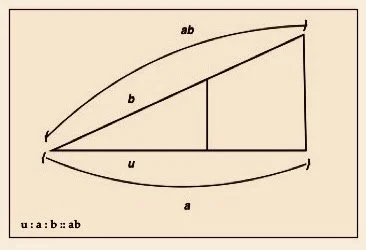
And if we give ourselves the ability to find fourth proportionals with any magnitudes, we can perform Cartesian Multiplication with any magnitudes of the same kind.
Descartes says of this construction: "[It] is the same as Multiplication. "[14] Well, it’s not. What we have here is his redefinition of it, fully as different and as important as the redefinition we attributed to Viete.[15] Here too, however, there is a crucial "defining" parallel to Euclidean Multiplication. It’s this: with Euclidean numbers it’s always true that
1 : a :: b : a × b .
Can you see it? The first is the same part of the second (one ath) that the third is of the fourth, so these numbers satisfy Euclid’s definition of same number ratio, Def. 20 of Elements VII.[16]
So: Descartes also applies a property of Euclidean Multiplication, and not the defining property, and, here too, a property relating to ratios.
This new operation too has a lot of new properties. I think that the two most fundamental ones are these:
First. Here, the product is a magnitude of the same kind as the factors. In this respect it resembles "strict" Euclidean Multiplication, where Vietean Multiplication is sharply different. In both strict Euclidean and Cartesian Multiplication, all possible factors and products form a closed system.
Second. This brings the "unit" into the very definition of "multiplication" is a way Vietean Multiplication does not. The unit is in a kind of limbo there, implied to a certain extent but not really essential. However, this is a redefinition of the unit or of "1," and it’s crucial to see this. Euclid defines a unit as "that by virtue of which each of the things is called one." (Elements VII, def 1, trans. Heath) That is to say, by virtue of Euclid's definition we call a grain of sand one grain of sand. An arbitrarily chosen line can't do that. Indeed, how is Descartes’ "unit" a unit at all? Well, he endows it with the multiplicative property of Euclid’s unit, namely, that any number times one equals that number. In just the same way, u times any line a equals a.
Here’s why. By Descartes’ definition, multiplying a line by the unit looks like this:
u : u :: a : ua ;
but of course u = u, so a = ua. So, what Descartes is doing is implicitly redefining the unit as the "multiplicative identity‘ 1,’" such that for all a, 1 ⋅ a = a.
Remarkably, instead of "multiplication" being defined in terms of a prior definition of "unit," as in Euclid, here "unit" can only be defined in the context of a definition of "multiplication"!
So: things with important similarities but essential differences have been substituted for "multiply" and "unit." Let’s accept this and consider some other crucial properties of our new operation.
First, it almost goes without saying that the factors don’t have to be commensurable, either with one another or with the unit.
Second: Here too, Euclidean Multiplication provides a computational rule—specifically, for finding the ratio of the product to the unit. As before, this is exact when the factors are commensurable with the unit and is always usable approximately.
Thirdly, as should be plausible given the second property, Vietean and Cartesian Multiplication, when applicable to the same given magnitudes, lead always to results which are consistent with each other—and with Euclidean Multiplication when it is applicable. Thus an algebraic equation which is true with one kind of multiplication, if applicable, is true with either of the other two. This fact adds a whole new level of flexibility or ambiguity in interpreting algebraic equations.
One of my favorite cases of this is example of the parabola. As we encounter it in Apollonius of Perga's account in Sophomore Math, the parabola is defined, like the other conic sections, by a characteristic ratio between its elements. In Conics I.11, Apollonius cuts the parabola into the cone so axis FG is parallel to the side of the cone AC. He contrives a magnitude FH so that the following ratio holds:
sq BC : rect BA, AC : : FH : FA
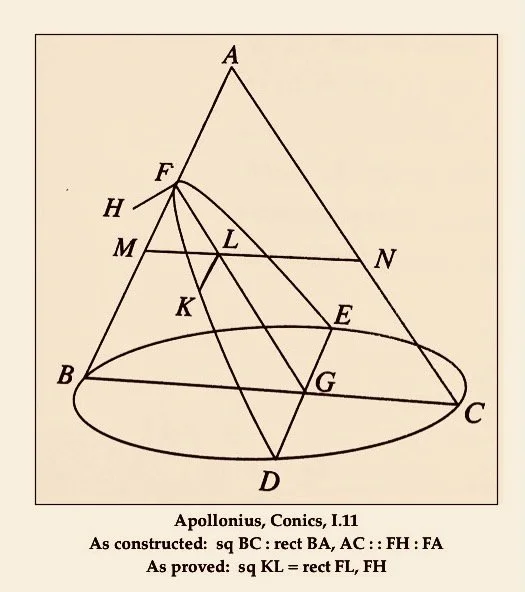
This strange hanger-on of a magnitude FH turns out to be crucial. Apollonius needs it to prove the defining characteristic of the parabola, one that is independent of the cone it is cut from. So he proves in the construction of the parabola that the square on the ordinate is equal to the rectangle formed by the abscissa and our friend FH, now called the "upright side" or the parameter. This equation defines the parabola, as I say, independently of the cone.
sq KL = rect FL, FH
At first glance, Apollonius' defining property of the parabola is quite different from the familiar "equation for a parabola" from high-school:
y = x2. [“x squared”]
If our high-school equation expresses Cartesian Multiplication, both x and y are lines. Given any x you can construct y; on coordinate axes, x is how far over you go horizontally, and y is how far up you go, to position any point on the parabola. This parabola has the y-axis as its axis, it goes through the point (0, 0), and it has horizontal ordinates, so that if an ordinate is a line equaling x, the abscissa it cuts off is a line equaling y.
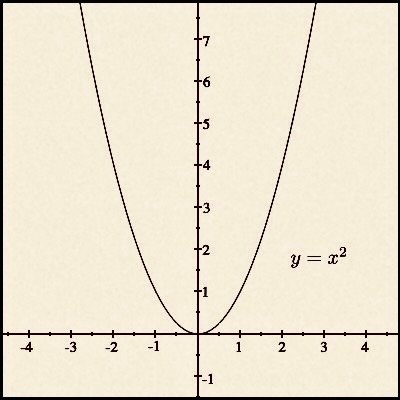
Now take this same equation and think of it as 1⋅y = x2, which of course must hold if y = x2. Interpreted with VieteanMultiplication, this says that the square on every ordinate equals the rectangle contained by the abscissa and the unit line, which is thus revealed as the Apollonian parameter belonging to the axis. So, the Cartesian interpretation tells you how to construct this parabola, and the Vietean interpretation states its Apollonian defining property. This is really rather beautiful.
Let us continue to praise this new multiplication, for it has two especially impressive new properties, one concerning fractions and the other concerning roots.
Fractions are intimately connected with division. Descartes gives us a definition of division; it’s the inverse of his multiplication. His definition of "a divided by b" or a/b is a line such that a/b : a :: u : b.[17] I myself think it’s more revealing to alternate and write a/b : u :: a : b, for example, 3/5 : 1 :: 3 : 5. The quotient of two lines, a / b, is just another linelike the factors a and b, and just as the product ab is. Call it a "Cartesian Fraction." It is easy to prove that if line aequals "3" (i.e. if it’s exactly three times as long as the unit line) and line b equals "5" (exactly five times as long), then the Cartesian Fraction a / b or "3/5" is a line which is exactly three fifths of the unit line. Furthermore, you can easily prove that this line "3/5" times any other line c yields a product, "3/5 x c ," which is a line equaling exactly three fifths of c.Finally, it is easy to prove that when multiplying Cartesian Fractions,
a / b · c / d = ac / bd
Can you see the importance of this? Cartesian Fractions tie in perfectly with the notion that a fraction is just another number (just as the unit now is). Then, Cartesian Fractions generate, in a provable way, the whole algebra of our commonsense, intuitive notion of how to multiply and divide fractions.[18]
As for roots: it is easy for Descartes to define roots. The square root of a line, for example, is the mean proportional between that line and the unit line. This is of course not the definition of a Euclidean square root, but once again, all Euclidean square roots have precisely this ratiometric property, since 1 : a : : a : a × a. Given Descartes' definition, it is easy to construct lines like "√2”, "√3" and "√6"—and it is not hard to prove that √2 · √3 = √6. Cartesian Multiplication gives us the whole algebra of roots, even when they are incommensurable, in a way which is entirely consistent with commensurable and integral square roots and which yields directly-intuitable results.
We must now leave this wonderful topic with a final remark: in your practical mathematical life you are sometimes in effect using Vietean Multiplication, sometimes Cartesian Multiplication, sometimes Euclidean Multiplication, and you switch over among the three, as demanded by the problem at hand, without ever thinking of the difference. Cartesian Multiplication does not supplant but rather complements Vietean Multiplication; the two together, plus Euclidean Multiplication, form a complex of related operations which is more supple and versatile than any of them by itself.[19]
4. Multiplying by –1
Let’s move to multiplying by –1. I must mention that both Viete and Descartes do a version of this, but the whole issue of negative numbers is actually distinguishable from the kinds of multiplying I’ve just discussed. The "negative" aspect is distinguishable from the ratiometric aspects. Thus I want to look at "minus 1" separately. Looking at –1 all by itself, then, we can see that here too fundamental things get redefined, including "greater than," "less than" and "equal to." They receive new meanings. It’s not that all along they’ve had these true deep inner meanings which you’ve been missing. They’re new meanings.
Now, they’re very abstract meanings (I’ll say more about that later), so in order to get at them let’s look at an old familiar application or interpretation of positive and negative numbers, the "number line."
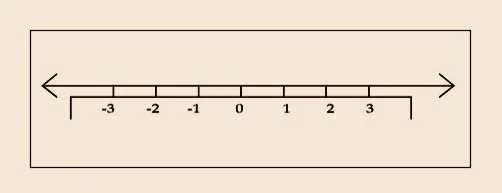
On the number line, "greater than" or ">" means "to the right of" or "farther to the right of", "less than" or "<" means "to the left of" or "farther to the left of" and "equal" or "=" means "the same distance from 0 in the samedirection." Plus, "negative" or "–" or "less than zero" means "to the left of the zero-point."
Now, this is not what is meant by the common English expressions "greater than" or "less than," let alone "less than zero." Remember the old conundrum, "How can you have less than zero cows?" Well, you can’t, not as long as "less than" and "zero" mean what they mean in everyday English. So what do the new meanings amount to? Well, "farther to the left or right" is similar to "greater than" or "less than"; but it adds directionality to the root meanings of "greater than" and "less than". It’s a directed distance or a diametrically-opposed distance.
Similarly, every application or instance of these terms beyond the number line implies an analogous redefinition, involving something analogous to directionality. This, in turn, reveals that we are dealing with a new family of magnitudes—"kind" isn’t strong enough a word here, since Euclid deals with different kinds of magnitudes but never dealt with these.[20] We can call them "diametrically-opposable magnitudes." Such magnitudes can possess one of two opposite "directions" or "senses," and they also have as one of their features a Euclidean-style size or magnitude. Thus they are more complex than any magnitude which Euclid recognizes.
Furthermore, the "diametrically-opposable magnitudes" have the following fundamental property: "Adding" a magnitude of one fundamental sense or direction has the same effect as "subtracting" an equal magnitude of the opposite sense. In the familiar symbols,
a + (–b) = a – b .
An example is credits and debits in a bookkeeping system.[21] Adding a credit has the same result on the bottom line as subtracting a debit, and adding a debit has the same result as subtracting a credit.
As you can see, we have also redefined "adding" and "subtracting" themselves. This is not what Euclid meant by these terms. You can see this easily on the number line. "Adding" a +1 to a −2 on the number line is a very differentoperation from adding those two line segments considered as Euclidean lines or magnitudes.
As another example of this new complexity, consider the idea of a "plus- three cows." This does not mean the same thing as three cows. Three cows is just three of those animals standing around in a field or whatever. "Plus-three cows" implies that there is such a thing as a "minus-three cows," and so it must mean something more complex. Now, exactly what it means actually depends on the context, and it can mean different things depending on the context. It must mean something like "three cows that someone owes me" or "three cows over the cargolimit, " or some such meaning analogous to directionality or sense.
Against this backdrop, then, let’s remind ourselves of what is meant by "times –1," since we all know how to perform this operation in a sedimented sort of way. It means this: you flip the sign of the multiplicand and keep its Euclidean-style magnitude the same. To "multiply by a negative magnitude" other than 1, you a) flip the sign of the multiplicand and b) determine the magnitude of the product using one of the earlier meanings of "multiplication," Euclidean, Vietean or Cartesian, depending on the problem. Given this as a definition, it’s clear that a negative times a negative equals a positive: for what it means to "multiply by a negative" includes flipping the sign of the multiplicand; and if that sign is negative, then the only alternative is positive: a "negative of a negative" must be positive.
I hope it’s clear what this operation, "times a negative," means—a meaning which I’ ve simply taken over from our high-school memory banks. But, now this looks like two different operations—you flip the sign, and then you multiply. Flipping the sign seems to mean something different in essence than multiplying. Why decide that it’s somehow "part of" multiplying?
For lack of time I am going to skip over some relatively commonsense or folksy approaches to this[22] and go straight to something much more formal or abstract, to wit: "flipping the sign" is associative, is commutative and is distributive over addition in just the same way that multiplying is in Euclidean and the other two multiplications.[23] I’m going to skip over the associative and commutative for lack of time and go straight to how flipping the sign is distributive over addition.
Again I rely on our memories of how to flip the sign of an expression. Take a − b. How do you flip the sign on that? What is −( a − b)? Well, we all know that it equals b − a.[24] But now, look at how you can arrive at this: you can "distribute" the negative sign over the parenthesis just as if you were multiplying:
– (a –b) = (–) a – ((–)b)
= – a – ( – b)
= – a + b
= b – a .
So, flipping the sign acts in the algebraic symbolism just as if you were multiplying by something. Furthermore, it leaves the magnitudes unchanged, just as if you were multiplying by 1. Finally, if you are flipping the sign and multiplying by some magnitude a, the minus sign and a distribute through any algebraic formula together, just as if they were a module of some kind. So it is possible, and very tempting, to merge the two and conceptualize them as "times −1" or "times −a".
The foregoing may seem like a weak reason to merge sign-flipping and multiplying. It’s convenient but not intuitive, and the reason may seem too merely formal, too symbolical or merely syntactical, to motivate yet another rethinking of multiplication.[25] However, in a way the redefinition is entirely appropriate to the new situation, and it reminds us of something important: "positive," "negative," "greater than," "less than" and so on in this new system only have a full meaning when they are applied or interpreted in a specific way. If asked "What does ‘negative a’ mean?" most people will say "Oh, you know, like on a number line, a to the left of zero," or if they know some physics, "Oh you know, like acceleration a but it’s slowing something down instead of speeding it up." In other words, they will give a specific interpretation of it. Why is this? It’s because you can’t state it by itself. It really is something merely formal or empty. Our new system is a set of signs referring only to themselves waiting to be given content from outside. Indeed, within a specific interpretation, certain aspects of "positive" and "negative" can simply drop out. These days nobody thinks of "negative charge" as "less than zero charge."[26] We simply drop the idea of "less than zero" here but continue to use positive and negative because of its great convenience.
Thus the same is true, in spades, of "multiplication" in this system: it also has an emptily formal character, one which can be filled out in very different ways. "Times a negative charge" means something really different from "times a negative acceleration." We must keep this firmly in mind as we turn to our last and seemingly most mysterious meaning of "multiplication."
5. Multiplying by i
Let’s cut to the chase:
i = √ –1
"i equals the square root of negative 1." How is this possible? Well, what does it mean? "Square root" means… what? In order to know that, you need to know what squaring means here, and therefore what "multiplication" means, here. What we’re looking at is a new meaning of multiplication.
If you ask, "What number times itself equals a negative 1?" the answer is, none, as long as multiplication means either flipping the sign or keeping it the same. We must conceive of a new operation, one such that doing it twice flips the sign "all the way." Thus doing it once must do something like flipping the sign "halfway"?
How can we make this thinkable? What presuppositions and redefinitions are necessary? First, a caution: when I say "thinkable," we must note that this new operation, which is based on "times a negative 1," will be just as emptily formal as it. Thus it would be really helpful to have instances or interpretations to get some kind of intuitive feel for it. Unfortunately, unlike with negative numbers, there are no simple, straightforward physical interpretations, so this whole section is going to have an extremely formal or abstract character (except for a fantastical example that I will bring in later).
We must forge ahead. What has to be redefined in order for this operation to make sense? Two things, in my opinion: first, we must conceive of a new kind of number and a new kind of system, and, second, we must redefine "positive" and "negative."
A new kind of number sounds weird, but less so if you recall the existence of different kinds of magnitudes. Think of this as a more abstract, formal version of a different kind of magnitude. In fact, we typically think that a "number" can stand for any kind of magnitude. All we have to do is add a unit-designation to it: "3 lb.," "980 cm/sec2," things like that. You can think of "i" as a permanent unit-designation which marks numbers as different in kind from those without it.We’ll see how this kind of assimilation of numbers to magnitudes will make this operation seem less foreign.
That’s because if you think of the situation this way, then you can relate this new multiplication to Vietean Multiplication. In Viete, after all, the product is always a magnitude of a different kind than either of the factors. Something similar happens here. However, the changes in kind here have a cyclical character totally lacking in Vietean Multiplication. There you always get a totally new kind of magnitude each time you multiply: it’s an open-ended, ever-rising "ladder," as Viete himself calls it. Here, when you multiply by i, the product is always one or another of the two kinds you started with. You can think of the two kinds, products and factors, as mutually-generating through repeated acts of multiplication. Together (only together!) they form a closed system under multiplication: they are conjugate or conjoined in a special way.
Here I will introduce my fantastical example. This is something that could have been true in science, although I must emphasize that it does not happen in fact. Still, if it did we would have something that acted a lot like our new multiplication. Juniors and Seniors know that if you have a helical coil of wire with current running through it you get a magnetic field within the coils. Now imagine that the following happened. You take a pith ball[27] charged with positive electricity, put it inside the wire helix, and run a burst of powerful current through the coil. Let’s call that process "multiplying by magnetism." Imagine that when you did so the pith ball came out no longer carrying a charge, but attracting the south pole of magnets and repelling their north poles—i.e., that it came out a north magnetic pole. Put it back in, zap it with the same current, and imagine that it came out this time carrying a negative electric charge, of the same magnitude as the original positive charge. Put it back in, zap it a third time, and imagine that it came out a south magnetic pole equal in strength to the north one—but of course opposite in sign. Finally, imagine that if you zapped this pole once more you got back your original positive charge. If this happened, then in terms of the cyclical transformation of the kinds of magnitudes it would be a lot like "multiplying by i."
In this example, the north pole is not electrified; it’s neither positive nor negative; it has no effect on other charged bodies; it can’t be added to the charge on anything; it’s neither greater than, less than, nor equal to the charge on anything else. However, it is potentially negative charge; it’s "halfway there," so to speak. You realize this potentiality by performing the operation again.[28] With these two fantastical conjoined magnitudes, each is the product of the other, each is characterized by "positive" and "negative", and each time a kind is produced it is of the opposite sign as the time before.
Clearly, this new system of conjoined magnitudes is distinctly more complicated than "positive and negative magnitudes." But those in turn were more complicated than non-directed Euclidean magnitudes, and this is no bar to our conceiving of this system in a formal way. Next, as I mentioned, we must redefine "positive" and "negative". Before, in Sec. 4, they represented something inescapably binary or diametrically- opposed. An intermediate stage was meaningless; it just wasn’t in that universe of discourse. Here we do have an intermediate stage. It is assigned to a magnitude of a different kind. Therefore, it is not directly-comparable with either "positive" or "negative" numbers, i.e. neither ">," "<" or "=," to them; but it is truly intermediate or intermediary, because of the cyclical relation under multiplication.
This is a new meaning. This is not contained in a hidden way in the original meaning of "positive" and "negative"—indeed it was excluded. You don’t have to try and believe that it "was there all along." A "plus three" does not mean the same thing in the new system as that phrase meant in my Sec. 4, because here it is understood that a plus three is the kind of thing that can participate in the cyclical process I have described, which was simply not a characteristic of the family of magnitudes introduced in Sec. 4.
However, having said all this about the new meanings, I think we should accept that it is perfectly possible to expand the meanings of these terms in this way, and that we are free to do so, if in doing so we get self-consistent, fruitful results.
Now, one reason that you do get self-consistent results is that multiplying by i is taken to be associative, commutative and distributive over addition. I won’t try to give sample equations illustrating this—for one thing, to get my full point across I’d need to invent a whole new notation, since with "i" there’s no way of notationally distinguishing thesign-flipping aspect from the multiplying aspect of "multiplying by i. " For this reason I wish i had come to be written as "⏊ 1" or something, a "half-way negative one." But that’s water over the dam. What’s crucial is this: multiplying by i has both a sign-flipping and a multiplying aspect, just like multiplying by –1.[29] Furthermore, the "halfway sign- flipping" aspect of multiplying by i is extremely similar to the "all-the-way" sign-flipping of my Sec. 4. Therefore, it should be no surprise that if you decree that the above properties belong to the new operation then no contradictions result there either. So, since it acts like multiplication you can call it "multiplication" and you can assign a multiplicative identity i to it.
I’d like to add that with this new operation the results you get are not only self-consistent but beautiful, and the more so the more you know about it. [30] The lack of clarity regarding i leads one to consider it as something resembling nonsense, something to be regarded with suspicion. This is a real pity.
We can now better understand all the mystery surrounding i. For one thing, nobody ever goes through all the distinctions that I’ve just gone through—and even more would be necessary in a really rigorous treatment. For another thing, i is typically presented as a special kind of number with an inherent special property such that if you try to "multiply" by it you have to get this halfway-sign- flipping result. But that’s completely backwards: there is no such inherent, prior, independent property of i necessitating any such result when you multiply by it. On the contrary: just as, with the Cartesian "unit," you have to know what "multiplication" means before you can understand what "unit" means—so here, i has to be understood, not priorly and by itself, but in terms of the new, much more complex version of "multiplication".
Conclusion
Two final questions: why did all these differences get obscured, and why do all these operations get called "multiplication" in particular? First, I am not a historian of mathematics, so I am not making any claims about what people like Descartes or Viete actually thought on these questions. Rather, I will try to give reasons for why these two developments were understandable, i.e. more or less defensible.
First, then: an important reason why all these operations got identified is algebra, because it is quite indifferent to all the distinctions which I have drawn. Think of how you use it. You take a problem concerning any kind or kinds of magnitudes and you translate it into algebraic symbols. From then on the algebraic manipulations necessary to solve the problem look the same no matter what, and the solution looks the same too. Furthermore, the manipulations are indifferent to what kind of multiplication is relevant to the particular problem. All that counts is that the operation "follow the rules of algebra."
That is to say, once you’re in the algebra, "multiplication" is any operation that, roughly speaking, is associative, commutative, distributive over addition, and possesses a multiplicative identity, with a set of derivative properties for "division". Thus, it is really quite natural that, given the power and ubiquity of algebra, any operation that possessed these properties came to be considered as "the same as" any other operation that did, no matter what the differences between them in other respects. Indeed, it seems natural that just these properties eventually came to be considered the hallmark of "multiplication" as such, with the specific kinds we’ve been discussing as special cases of the universal operation, each with its peculiar quirks and limitations. "Multiplication" now means the genus of which the original meanings are species; indeed, it is almost more like their Idea, since it alone possesses all the properties in all their purity.
As to the second question: one could imagine that all these operations could have been considered the same but then been called "compounding" or "proportionalization" or something. Why the arithmetical term? Algebra is deeply involved here too, for this question is related to another one: why did algebraic symbols come to be called "numbers" as they are today? The following speculations are directly influenced by Klein’s discussion in Origins of Algebra, although I am not putting them forward as an explication of his thought. In my opinion, this development in terminology was part of an attempt to make the size of all magnitudes "speakable." It goes hand in hand with the redefinition of "number" itself, the move from the ancient to the modern conceptualization of "number."
In Klein’s book you see this most clearly in a mathematician named Simon Stevin, a contemporary of Viete’s. In his 1585 Arithmetic, as Klein quotes it, here is his definition of "number": "Number is that by which the quantity of each thing is revealed."[31] This is a revolutionary change from "a multitude composed of units." First off, "each thing" means a magnitude of any kind: number is now intended as a way of indicating the quantity of any magnitude, as a universal indicator of quantity of size. Next, put negatively, number itself is no particularmagnitude,nor any multitude. Its new universality necessitates a new abstractness. (If you’re wondering how anything could play this role, lying behind these new universal size-markers is a further redefinition and etherealization of "unit." We cannot go into this here, except to note that, eventually, the new "number" came to mean virtually the same thing as "ratio.")[32]
Next, this new number is a "revealer" as opposed to the revealed quantity. It’s more abstract because it is only the name, as opposed to the thing named. That’s in stark contrast to Euclid. In Euclid the number is the multitude; it has a name, say "6," but it is distinct from its name. With us it’s more like Stevin—the number is the "concept." If asked, "What’s ‘6’ by itself, not 6 of anything, just the number 6?" we tend to say, "Well it’s just the concept, 6," and think we are describing the number itself. Euclid would never agree to that: "just 6" is no more the number composed of 6 units than the word "red" is the color itself.
And now to conclude my conclusion. As Klein argues, this redefinition won out over Euclid’s old definition because it was tied to algebra, to this immensely successful universal art designed to solve problems involving any kind or kinds of magnitude. So, a crucial reason why this set of operations all got called "multiplication" is that a set of universally-applicable symbols or names of an essentially algebraic type all got called "number."
Henry Higuera is Tutor Emeritus at St. John's College in Annapolis. This lecture was first delivered on the Annapolis campus on April 17, 2009.
END NOTE 1
On the Commutative, Associate and Distributive Properties.
It is striking how little emphasis Euclid puts on these properties. He proves that strict multiplication is commutative at Elements VII. 16.[33] In effect he proves that it is distributive over addition in the course of VII.5, but you would notknow that from the enunciation.[34] To the best of my knowledge he does not prove that it is associative.
It is easy to prove that compounding ratios, viewed as an operation, is associative—i.e., given three ratios, if you compound the first two of them and then compound that result with the third, you end up with the same ratio as if you first compounded the second and third. It is also easy to prove that the operation is commutative. As a result, the same can be said of Vietean Multiplication.
It is easy to prove, using Euclid Elements Book V, that Cartesian multiplication is associative, commutative and distributive over addition.
The situation is more complicated with Vietean Multiplication and the distributive property. That multiplying lineshas this property is easy to show on the basis of Euclid Elements, Book. II. I am inclined to think, however, that with other kinds of magnitudes one should not take this for granted. In other words, it must be independently verified, perhaps empirically, whether, for example, two masses going at a certain speed have the same total momentum as one mass of their combined weight going at that speed. I remember the old Freshman Lab Manual having a discussion of this with respect to "turning power."
END NOTE 2
Isaac Newton on Number and Multiplication.
I cannot resist quoting from a 1720 translation of a late work (1707) of Isaac Newton’s, called the Arithmetica Universalis. (I have altered the translations a little.) First, on number:
By number we understand not so much a multitude of units as the abstracted ratio of any quantity to another quantity of the same kind which we take for unity.
Thus, he signs on to the revolutionary new concept of number described above. Next, on multiplication:
Multiplication properly so called is the result produced by integers when we seek a new quantity which is as many times greater than the multiplicand as the multiplier is greater than the unit [i.e., Euclidean Multiplication.] However, for want of a better word, Multiplication is also made use of in fractions and irrational numbers, for finding a new quantity in the same ratio, whatever it be, to the multiplicand that the multiplier has to unity [one]. Nor is multiplication made only by abstract numbers, but also by concretequantities [i.e. magnitudes], as by lines, surfaces, motion, weights &c., as far as these may be conceived to have the same relationship to some other known quantity of the same kind taken as unity. [I.e., Cartesian Multiplication.]… Custom has obtained that the generation or description of a surface by a line moving at right angles upon another line should be called the multiplication of those two lines. For though a line, however multiplied, cannot become a surface, and consequently this generation of a surface by lines is very different from multiplication, yet they agree in this: the number of units in either line multiplied by the number of units in the other produces an abstracted number of units in the surface comprehended by those lines, if the unit of area is defined as it usually is, namely a square whose sides are unit lines. And there is the same analogy between a solid and the result of multiplying three quantities. [I.e., Vietean Multiplication.] …
As you can see, Newton rather wishes that other terms had been found for the two new "multiplications," but he is not willing to disturb usage which was already customary in his day.
These quotations are from the Google Books pdf of the Universal Arithmetick; emphasis is mine.
Notes
[1] Finer distinctions might have been possible. See n. 31 below.
[2] For his technical definition of multiplication, see "Continuity and Irrational Numbers" in Essays of the Theory of Numbers, Beman tr., Dover Editions, pp. 22–23.
[3] Isaac Newton, for one, did clearly state some of the distinctions I’m going to make. See my End Note 2 below.
[4] He may not have been the first to do so in real time. Thinking of compound ratio as a kind of multiplication might be a natural move for anyone of the many authors between al-Khwarizmi (820 CE) and Viete who are thinking about both algebra and Euclid. It seems possible, for example, that Abu Kamil, Thabit ibn Qurra, or Leonardo of Pisa treat ratios as equivalent to quotients and compound ratios as products. Thanks to Brendon Lasell for his help clarifying this point.
[5] See Jacob Klein, Greek Mathematical Thought and the Origin of Algebra, Eva Brann, tr. (M.I.T. Press, Cambridge, 1968): pp. 315—353 (tr., J. Winfree Smith).
[6] To see what might not work, try using 8 instead of 10. If 2 : 3 :: 8 : 12, and 5 : 6 :: 12: M, no whole number can be found for M. 12 : 14 : : 6 : 7 is a smaller ratio than 5 : 6; and 12 : 15 :: 4 : 5 is bigger.
[7] Klein, op. cit., p. 323.
[8] It also doesn’t apply it to new objects, since as we have noted Euclid applies repeated addition to lines as well as triangles, angles and arcs of circles.
[9] They certainly don’t have to be in Elements VI. 23. (Two incommensurable magnitudes have no unit measure in common. Most famously, the diagonal is incommensurable with the side of the unit square.)
[10] In the original Latin, not just modern translations.
[11] "Joint variation" is shorthand for compounding ratios. "A varies (jointly) as B and C" or even (more concisely) “A isas B and C” means A1 : A2 comp. B1 : B2 , C1 : C2 .
[12] Emphasis added. See Cohen, tr., The Principia (U. of California Press, Berkeley, 1999), p. 425. Also, here Newton uses the Latin term "ducere" rather than "multiplicare" ; as near as I can tell, however, these two terms were used interchangeably in Newton’s time. See Cohen and Koyre, ed., Isaac Newton’s Philosophiae Naturalis Principia Mathematica (Harvard, Cambridge, 1972): Vol. I p. 67.
[13] Klein, op. cit., p. 332
[14] Smith and Latham, tr., The Geometry of Rene Descartes (Dover, New York, 1954): p 3.
[15] Once again, we restrict ourselves to authors that we read at St. John's.
[16] Definition VII.20: "Numbers are proportional when the first is the same multiple, or the same part, or the same parts, of the second that the third is of the fourth" (trans. Heath.)
[17] See Geometry, op. cit., p. 3.
[18] You can also see the similarity between multiplying Cartesian Fractions and Vietean Multiplication (and thus compounding ratios). This is hardly a coincidence, but we can’t go into that here. But we must note the resemblance that has arisen here between a fraction or quotient in Descartes and a ratio in Vietean Multiplication. And see our n. 32 below.
[19] For Isaac Newton’s take on these three kinds of multiplication, see End Note 2 at the back of this paper.
[20] Also, there can be differentkinds of these new magnitudes—velocities, distances, electric charges, &c&c.
[21] An example which Isaac Newton himself gives in his Arithmetica Universalis.
[22] Including Viete’s own discussion. See Klein, op. cit., p. 333.
[23] For a discussion of associative and so on, see End Note 1. at the back of this paper.
[24] Euclid would admit this in a qualified sense. He admits subtraction of lines, and he would agree that if we’re given three lines a, b and c (with b smaller than a), then c minus(a − b) does indeed equal c plus b minus a. He would of course object to writing "−(a − b)" as a stand-alone expression; but historically, the rules we’re familiar with for "flipping the sign" were chosen in order to preserve the equivalency between "subtract (a − b)" (from some other line) and "a minus (a −b)" (as a stand-alone expression).
[25] Look at the example Viete discusses (Klein, p. 333), which is essentially (a − b)(c − d). You are perfectly free to think of (c − d) as "c minus d" and thus to interpret the result of that multiplication as "(a − b) times c minus (a − b) times d" which, as Euclid could tell you, equals (a − b) times c plus bd minus ad. You never have to think that you are "multiplying by a negative b" to get the "plus bd" term.
[26] Benjamin Franklin did think of it in somewhat this way, as the Juniors and Seniors know. Historically, we rejected his full theory, and thus his reason for calling negative charge "negative," but kept the notation because it served our purposes so well, and we thus completely reinterpreted what was meant by "negative charge".
[27] Freshmen and Sophomores will eventually encounter these: cork balls about the size of peas.
[28] For that matter, it’s also potentially positive charge again; all you have to do (fantastically) is multiply by"negative magnetism," i.e. zap it with current running the other way. This is the analogue to multiplying by –i.
[29] Multiplying by 6i, for example, can be thought of as 1) halfway flipping the sign and 2) using the 6 to adjust the magnitude of the product according to Euclidean, Vietean or Cartesian Multiplication.
[30] This discussion of multiplying by i is very incomplete, for it does not mention complex numbers, which are intimately associated with this new operation. Sadly, there is no time to clarify or develop this immense and beautiful topic any further.
[31] Klein, op. cit., p. 191
[32] Indeed, Newton himself took number to be essentially the same as ratio. See the first quote in my End Note 2 below. Klein gives a 1657 quote from a mathematician named John Wallis who is more subtle than Newton on this point: number is not a ratio but is the "index" or "indicator" of a ratio. Klein, op. cit., p. 220.
Furthermore, one can easily define "multiplying by a ratio" in the spirit of the redefinitions which I have discussed. Let "multiplying any magnitude M by A : B," mean finding a product P such that it has to M the same ratio as A has to B. This means that P : M :: A : B, so actually this too is finding a fourth proportional. Why call this "multiplication"? Because Cartesian Multiplication by a quotient has exactly this property. Let m, a and b be lines andlet m⋅ a / b = p; then you can prove that p : m :: a : b. I had to decide whether to consider this and "multiplying by fractions" to be distinct kinds of multiplication, and eventually I thought it best to include them both under Cartesian Multiplication. See Section 3 and n. 18 above.
[33] "If two numbers by multiplying one another make certain numbers, the numbers so produced will be equal to one another" (trans. Heath).
[34] "If a number be a part of a number, and another be the same part of another, the sum will also be the same part of the sum that the one is of the one" (trans. Heath).