Artistic expression in animals
Linda Wiener
I have three main goals in this lecture. The first, and most important, is to inspire you to be more open to and aware of the animals all around you. The second is to give some history of a fascinating debate on animal color and behavior that began in the early twentieth century in the United States; this will illustrate how difficult it is to elicit any sort of Truth from the phenomena of nature. The third is to persuade you that, at least some of the time, animals engage in artistic expression for its own sake.
Ever since Charles Darwin published On the Origin of Species in 1859, by far the most popular way of interpreting the appearance and behavior of organisms has been through the theory of natural selection.[1] According to this theory, if a mutation appears in an animal and that mutation helps the animal survive and reproduce better than similar animals in their environment, the mutation and the animals that carry it will be preserved while others will eventually decline and die out. But ever since this theory was published there has been dissent. The most well known dissents are from religious objectors, however there have always been some scientists, naturalists, philosophers, and others who work intimately with plants and animals who accept the theory of evolution through natural selection, but believe that it is not sufficient to account for all the phenomena of nature. I am one of this latter group.
In this lecture, I will use the lens of artistic expression in animals as a way of exploring this question. I begin with an example from bird song. I was at a performance of Beethoven’s Ninth Symphony, given by the Santa Fe Community Orchestra at the Santa Fe Opera House in May, 2008. The opera house is covered on top, but open around the sides. At the very beginning of the third movement, a flock of house finches flew in and perched above the orchestra. One male joined in singing with the music in such a way that it seemed a part of the piece. He sang for most of the third movement and at the very end of that movement, when the orchestra plays four notes, the bird came in afterward, using the contact chirps of the species, and mimicked those last four notes.
This is an example of a bird singing in his capacity as a musician. He shows that he knows something about music and can employ it appropriately outside its use for attracting mates and protecting territories. This propensity of a least some birds to sing outside the mating and nesting seasons was noted by Thoreau and more recently by David Rothenberg in his book Why Birds Sing.[2] David is a philosopher and jazz clarinetist. He plays his clarinet with birds in aviaries and in the wild, sometimes with remarkable results. As with the bird at the opera house, some birds respond musically to his musical prompting. I particularly like a duet he participated in with a laughing thrush; it can be heard online. [3] Rothenberg concludes that birds sing because they enjoy it.
Other animals have been reported to respond to human music. I read that crickets will approach when they hear music and start singing. My own experiments with two species of crickets were inconclusive; they chirped so much it was hard to tell when they were responding to music and when they were chirping in their natural rhythms. I have been told stories of raccoons coming on stage during a concert. There is also record of a bear doing the same thing (Fig. 1).[4]
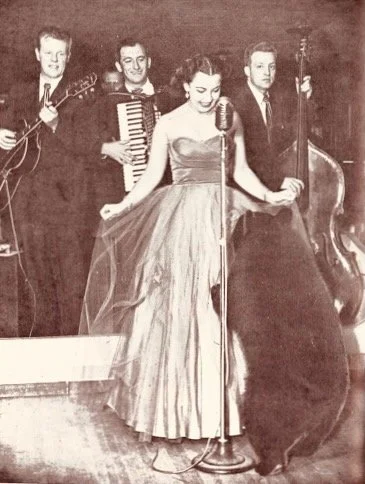
Figure 1.
Bear at concert.
(From Carl Marty, Northenaire's Ginger and Her Woodland Orphans (Park Falls, Wisconsin: MacGregor Litho, 1953)
Moving on from music, probably the most famous artistic animals are the bowerbirds of Australia and New Guinea. For instance, the satin bowerbird builds an oval shaped bower out of sticks and decorates it with mostly blue objects. This includes flowers, berries, and even human-made items like plastic drinking straws. Other species have differently shaped bowers and use different color schemes. The vogelkop bowerbird builds a conical bower and decorates mostly with red and orange objects. [See images here.] The females come around to check out the male bowers, the males dance for them, and then the female selects a male to mate with. She then goes off to build a nest and raises the young on her own.
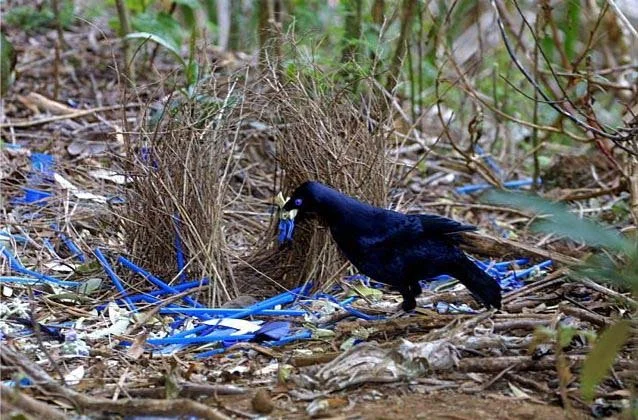
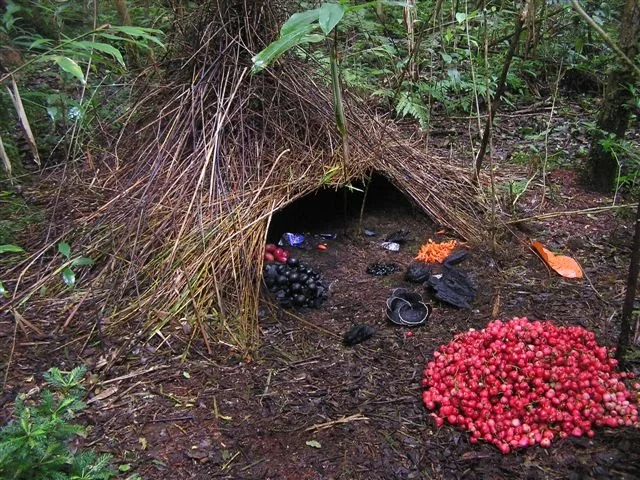
This is a classic example of what Darwin called “sexual selection” in his book Descent of Man and Selection in Relation to Sex.[6] In Darwin’s account, the females have aesthetic standards and whichever male best meets those standards is the one she chooses as a mate.
Darwin thought sexual selection less rigorous than ordinary natural selection because it was not a life and death matter. Recently, Darwin's view of sexual selection has been revised. Now, the building, decorating, and dancing activities of the male are seen as direct reflections of the actual genetic quality of the males. The females are selecting the males not according to an aesthetic standard, but according to which are the most genetically fit. This brings sexual selection theory more in line with the classic theory of natural selection.
A group of birds called the catbirds, in the same family as the bower birds, helps raise a few questions about this modern understanding. In the catbirds, the males and females cooperate to build the nest and rear the young; on average catbirds rear more off spring than the bowerbirds. An alternative explanation for bower- bird behavior is that the bower birds have “chosen” in some way to forgo their maximum reproductive potential in order to devote energy to the creation and appreciation of art.
Closer to home, there are other collecting and decorating animals. The pack rat of the Southwestern states is one. They are beloved by archaeologists because they collect all sorts of things from their surroundings and store them in their nests. An ancient pack rat nest can tell scientists a lot about the sorts of things that were around at the time. Pack rats are also famous for being destructive when they choose to nest in your home or vehicle. Whenever I hear friends complain about a pack rat nest, I beg them for photographs.
Pack rats have different preferences when constructing their nests. Sometimes, it is just a bunch of sticks and a few fabulous items they have collected. My friends Betsy and Jamie had a nest in their vehicle with a central white fluffy nest structure, then an attractive bed of greens with dried red chiles piled in the center (Fig. 2a). My friends Robert and Susan had a pack rat nest in theirvehicle with a central grey fluffy nest structure surrounded by a variety of sticks, stems, and cholla cactus pads (Fig. 2b).
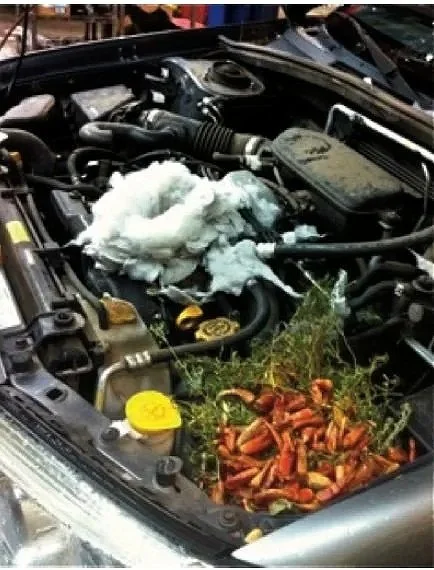
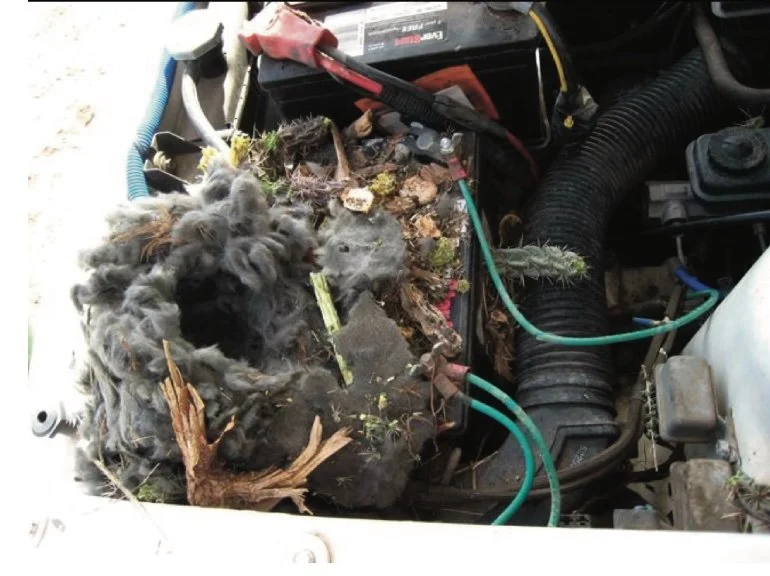
Another friend, Pam, tells this story about a pack rat nest she found in her truck. She was so mad when she saw the nest, she threw everything on the ground; when she came back some time later, it was all back in the truck. Not only that, it was back in just the way it had been before, with each major element, stems, sticks, and other items in exactly the same spot. This shows us that the nest isn’t just a bunch of stuff thrown around. The pack rat arranges her space to her own taste. Just as when someone messes up one of your rooms, you put it back to its original arrangement, so too does the pack rat.
Let’s look at some domestic animals. I had three ferrets over a period of about nine years. They were all avid collectors. They had stashes of the stuff they collected; there was a main stash usually under and couch or in a cabinet, and smaller satellite stashes in various locations. I noticed that they went through periods of collecting. My ferret Fennel collected soft things like beanie babies and stuffed animals for a while and then switched to hard things like pill bottles and vials. They also had a sense of value. If they found something unusual, it would be hidden way in the back underneath other items in the stash, whereas a common object like a pencil would just be thrown in anywhere.
My colleague Llyd Wells in Santa Fe has a ferret named Tomato who makes stashes.
Tomato keeps a stash of mostly soft items in the closet in the bedroom (Fig. 3a) and another stash of mostly harder rubber items under the sink in the bathroom (Fig. 3b).
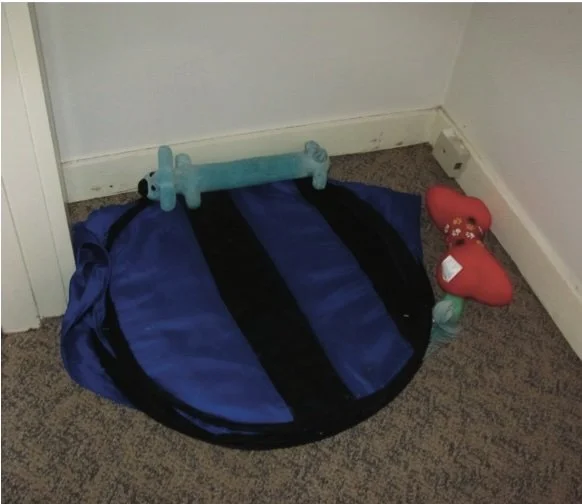
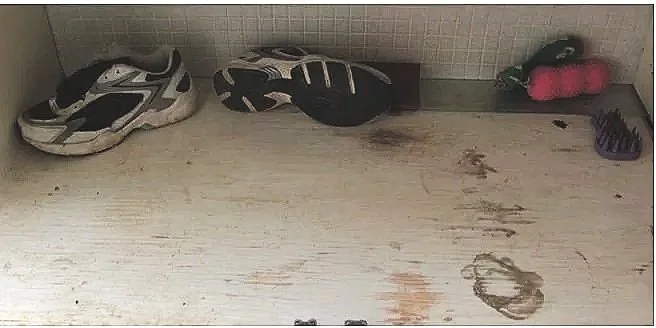
Llyd will switch an item out of one stash into the other and Tomato is quick to “correct” this. Tomato has organized her stashes and knows how they are supposed to be.
If it seems like I am talking about ferret collecting in much the same way I might talk about human collecting, it is because I am. This brings up the bad word anthropomorphism. I am accused of projecting my own desires, intentions, and activities onto the ferrets. However, if I see an animal acting in much the same way I would in a similar situation, why shouldn't I, at least as a first step, assume that it is acting with similar desires and motivations? After all, the ferret, the pack rat, and me are all children of nature. We have all evolved on this earth; why should we be assumed to be so alien to one another?
Here is one more example from our domestic animals. Robby is a dog who belongs to friends Jonathan and Barbara. He has a basket of stuffed animals and when his people are away he makes
careful arrangements of them on the living room floor. A typical one has four evenly spaced animals in a straight line, with one off center (Fig. 4a). A slightly more complex arrangement has two of the same animals, in different colors, together. There are two animals, evenly spaced on either side of these two and then down from the ends, another animal on each side with different, but still even, spacing (Fig. 4b).
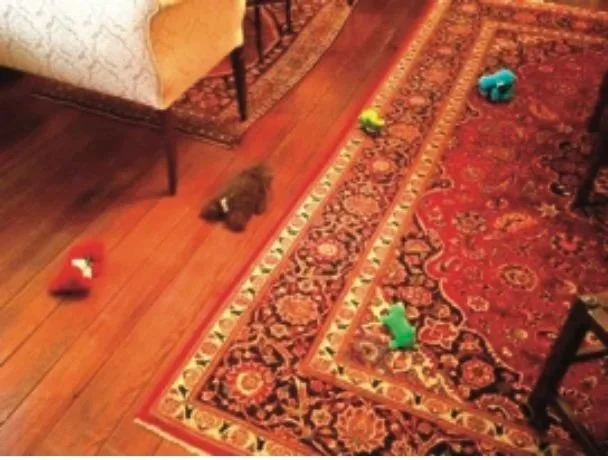
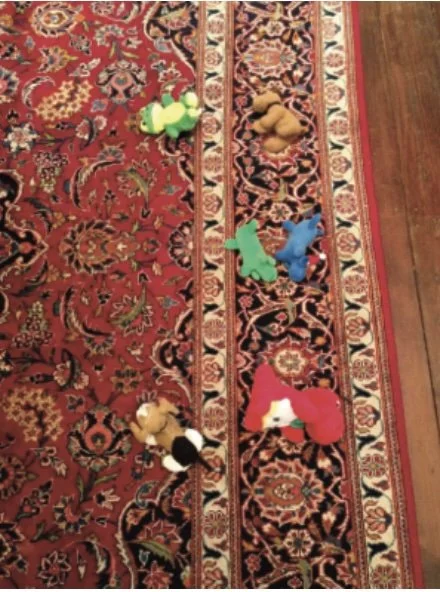
Also typical of Robby’s work: the stuffed frog is in every arrangement. This is definitely not the work of an animal just throwing things around because he is mad that his people are away.
A few years ago on YouTube there was a doberman who made similar stuffed animal arrangements, though he went in more for circular patterns. Let me take a moment to recommend YouTube as a valuable source of information about animal behavior. Now that most people have small video cameras or cell phones with them all the time, an amazing variety of animal behavior has been recorded and put online. Behaviors that I would have been called crazy for reporting ten years ago are now accessible to everyone. And everyone can judge for themself.
These collecting and decorating behaviors show us a range of possibilities in nature. They are essential to the reproductive biology of the bower birds and certainly serve a utilitarian function for them. For pack rats and ferrets these activities are typical of the species, but do not serve any essential functions that we know of. Robby the dog’s activities are not at all typical of the species, but such behavior pops up now and then among dogs. I have read of other cases in which one or a few animals engage in these kinds of activities, though, again, they are not typical of the species. There were a group of pigs[7] who made arrangements out of shingles and dirt and even a wolverine who made arrangements of sticks in a chain link fence, left them up for a few days, and then made a new arrangement.[8]
I suggest that the musical, collecting, and decorating activities I have been chronicling are not always specifically evolved to serve mating rituals or other survival needs, but may be part of a much broader expressiveness in the natural world that can be turned to utilitarian functions, but need not be. When we look at invertebrates, it is a little harder to judge what they intend, because they are not so closely related to us. Let’s look at a few examples that might count as art for art’s sake.
The decorator urchin collects various materials from the ocean floor and puts them on top of its spines. I have read that this is for camouflage, but the photos that I have seen do not support this; they are all highly visible.
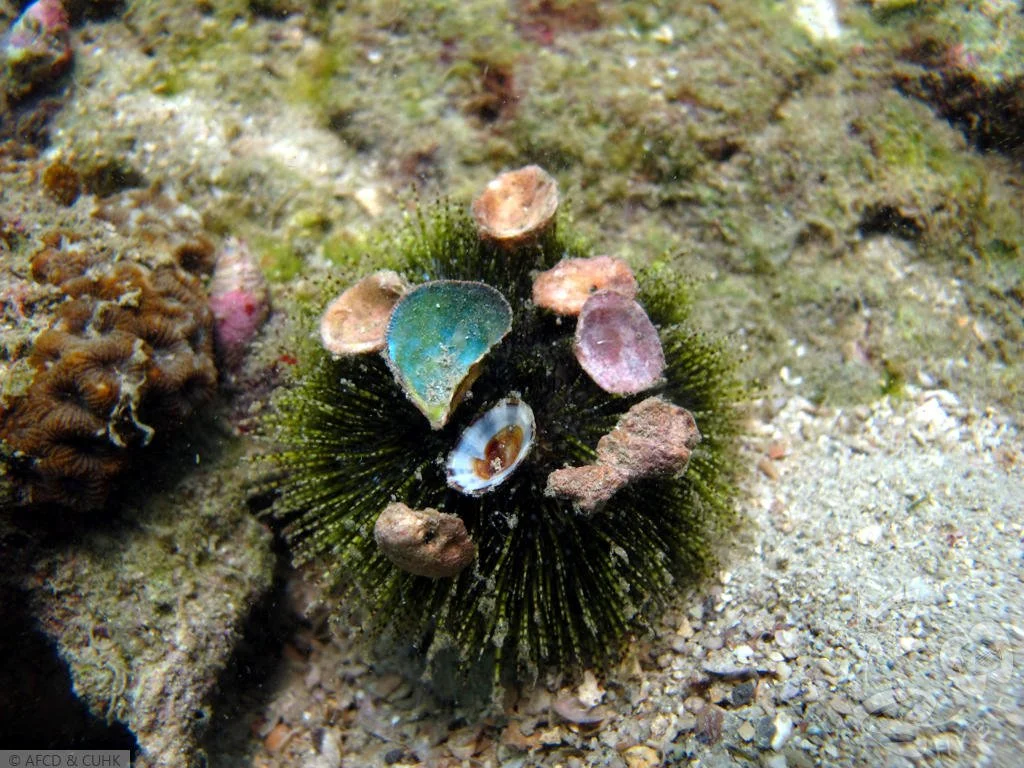
Decorator urchin.
Photo by the Hong Kong Biodiversity Information Hub (https://bih.gov.hk/en/multimedia-database/species/index.html?id=5971
Harvester ants are common in the Southwestern United States. Their nests are covered with small stones and are famous as collecting sites for various materials that people want. Some are covered in crystals and sparkle in the sun. People know they are the place to go to find turquoise and beads. Paleontologists find small fossils from rodents on their nests, and scientists studying radioactive minerals go to their nests to find trinitite, the mineral formed from the first atomic bomb test at the Trinity site in New Mexico.
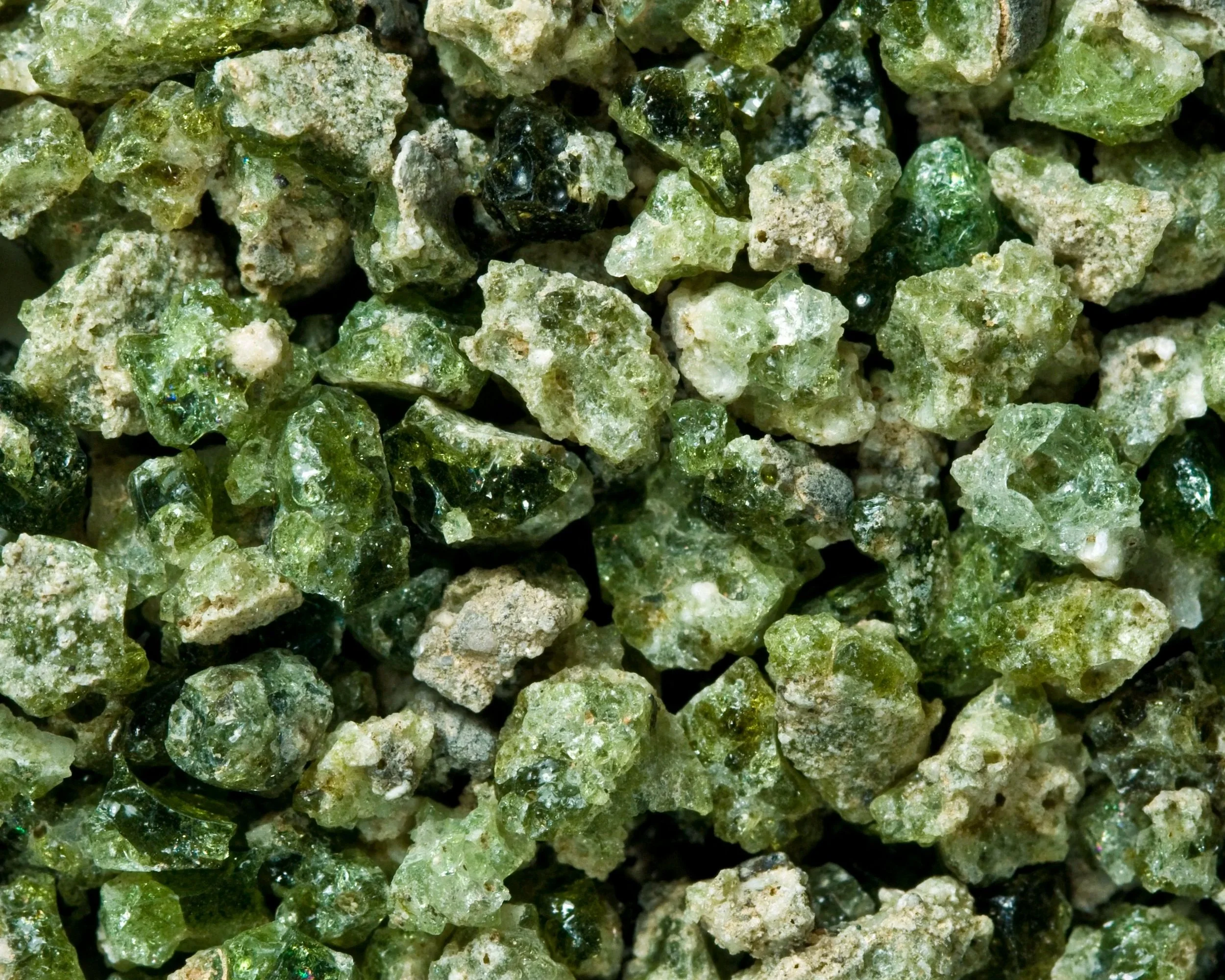
Trinitite collected from ant hills in the vicinity of the Trinity Test Site in southern New Mexico.
Photo by Mouser Williams (https://www.flickr.com/photos/mouser-nerdbot/5334689193)
Garden spiders, also called writing spiders, build orb webs and decorate them with zig zag patterns that are different for each species.[11] Henri Fabre, the great French entomologist, called these their “signature.” I had, until recently, not read any plausible accounts of their function. It turns out, however, that the silk in the “signature” is different from the web silk. It reflects ultraviolet light and may function to attract insects into the web.
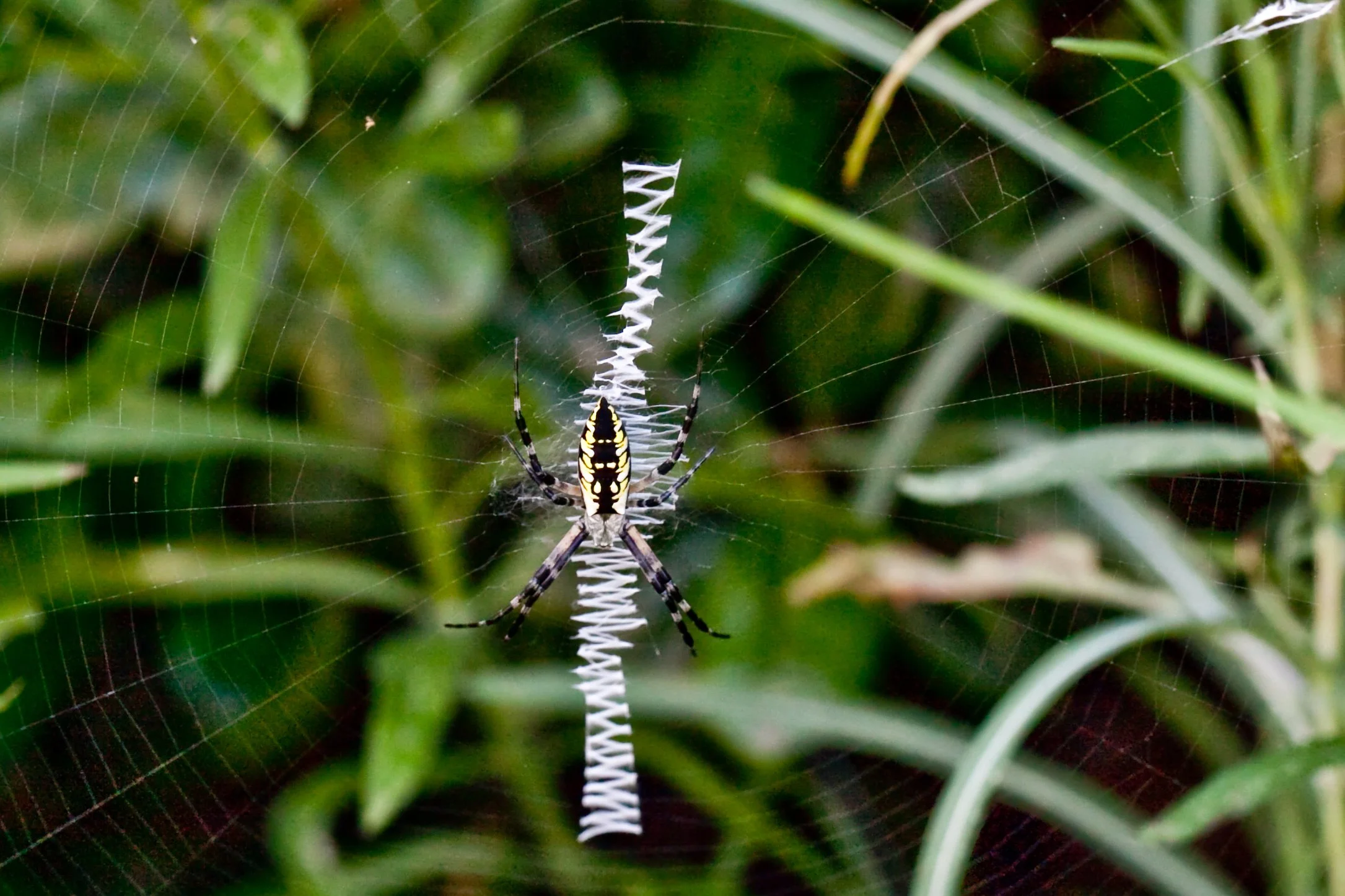
Yellow garden-spider’s web.
Photo by Hmendoza356 Deisy Mendoza - Own work, CC BY 3.0, (https://commons.wikimedia.org/w/index.php?curid=10992347 )
This is still untested, but does seem plausible. Even so, a further question is why the web is decorated in just this way. Why do such decorations seem more than is needed to fulfill the functions they serve? This is one of the main questions that David Rothenberg, the man who wrote Why Birds Sing, pursues in a more recent book called Survival of the Beautiful.[12]
Usually when we think about animals and art, we are not thinking about the arrangement of a pack rat’s nest or the beads on a harvester ant’s nest. We are thinking, rather, that animals are beautiful.
Humans have long appropriated bird feathers and animal skins for our own adornment. I am an entomologist, and so I look at insects a lot. Consider this beetle (Fig. 5)—the highly ornamented form of the legs, the shape and texture of the thorax, the colors and patterns on the wing covers.
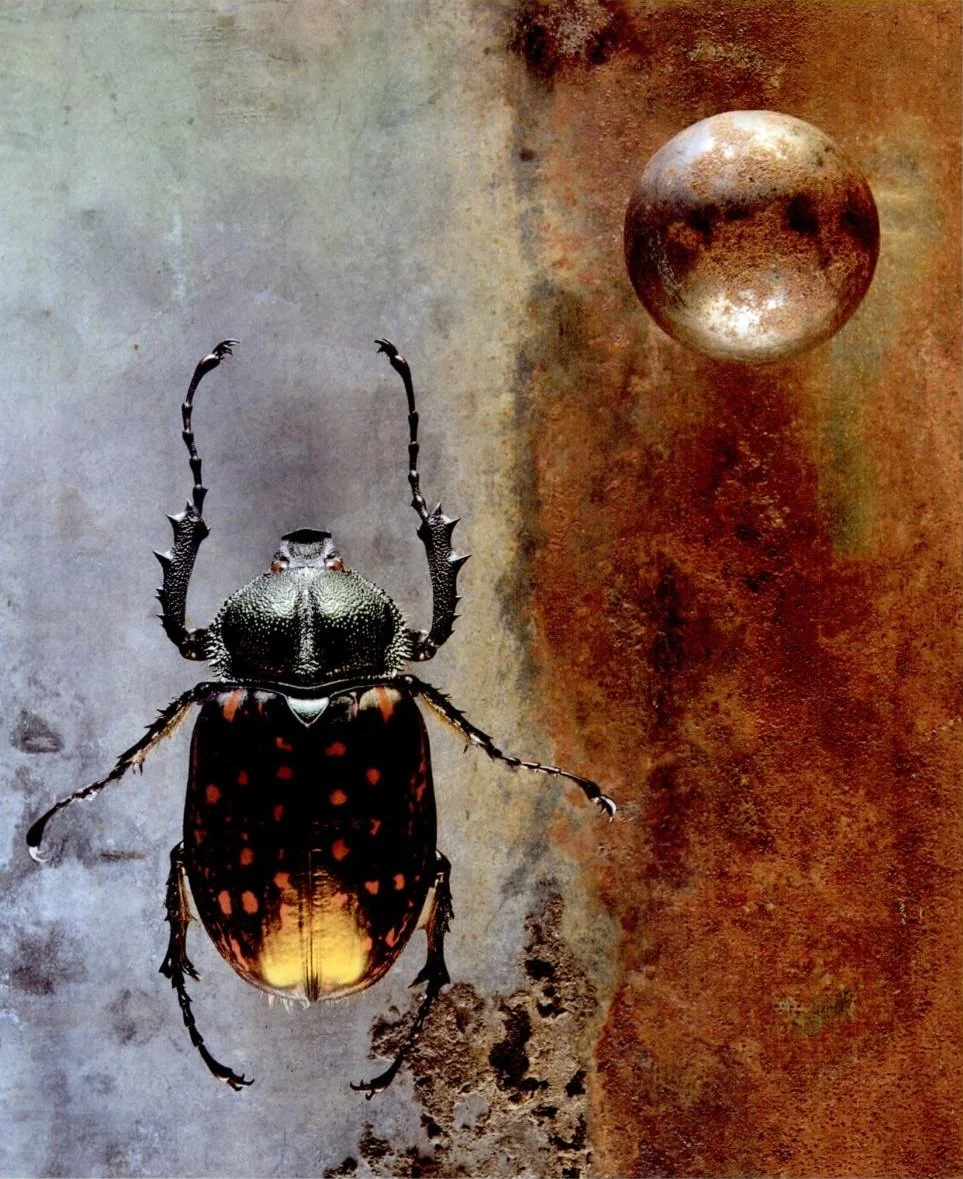
Figure 5. “Coleoptera” by Jo Whaley.
(Jo Whaley, Deborah Klochko, and Linda Wiener, The Theater of Insects (San Francisco: Chronicle Books, 2008).
It is a fantastic animal and only has to be put on a background and photographed to be easily seen as art. This is one of the ideas behind a book, The Theater of Insects,[13] that I collaborated on with photographer Jo Whaley.
Other insect colors are understood as serving important protective functions. The great purple hairstreak, a butterfly I see in New Mexico, has prominent white polka dots set in a black background on its head and thorax, a bright orange abdomen, and iridescent scales on its wings.[14] The top of the wings are a beautiful irridescent purple. The bold black, white, and orange colors are referred to as warning coloration. Insects that are poisonous such as the black and orange monarch butterfly, or dangerous like the yellow-and-black-striped wasps and bees, have these kinds of color patterns. The theory is that predators such as birds learn to avoid these patterns and so the animals are protected. Also, insects that are neither poisonous nor dangerous may evolve these patterns to fool predators into refusing to eat them.
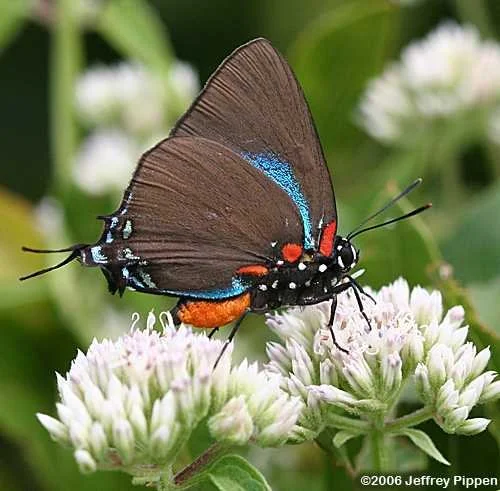
Great purple hairstreak.
Photo by Jeffrey Pippen. (https://www.jeffpippen.com/butterflies/greatpurplehairstreak.htm)
The peacock spiders, a group of jumping spiders, have wonderful bright color patterns, and special flag-like structures on their second pair of legs. They do elaborate courtship dances for the females.[16] This again seems like a classic example of sexual selection in that the colors, patterns, ornaments, and dancing serve an essential function in attaining a mate.
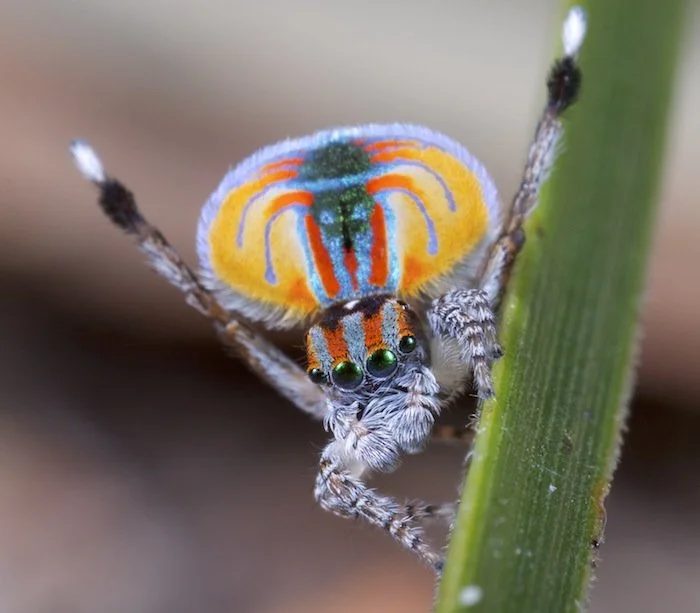
Male peacock spider.
By Jurgen Otto, CC BY-SA 2.0, (https://commons.wikimedia.org/w/index.php?curid=31209998)
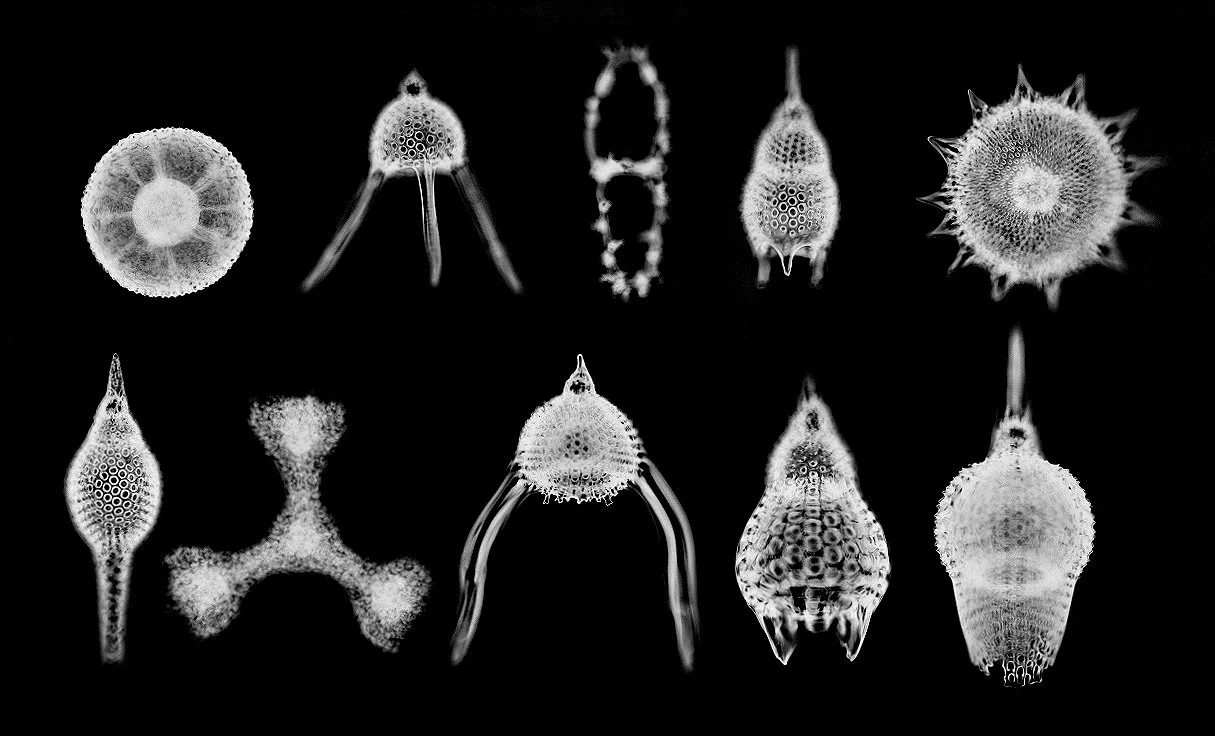
Consider, however, the radiolarians. They are one-celled animals that live in the ocean. They are an old lineage, existing for over 600 million years. They have an amazing variety of forms, ornaments, and textures that serve no known functions. It seems that as soon as there were animals, even just single-celled ones, there was already a tendency toward elaboration. Again, I suggest that such elaboration may be part of a basic expressive function of nature. Such appearances are not necessarily evolved to serve particular survival or reproductive functions.
Hold that thought. Now I am going to turn to the debate I mentioned earlier. Abbott Thayer was a well known portrait painter in New England at the turn of the twentieth century. He was famous for portraits of women with angel’s wings. He was also famous for his theory of animal coloration. With his son Gerald, he published a book in 1909 called Concealing-Coloration in the Animal Kingdom.[18] I came across this book quite by accident about eight years ago and was enthralled by it. Contrary to the theory of his day, and also contrary to the theory of our day, the Thayers thought that all animal colors were concealing.
The frontispiece of the book, a painting, shows a male peacock with his colorful tail concealed in the colorful leaves on the forest floor and his beautiful blue neck concealed against the sky (Fig. 6). This vantage would be from the point of view of a ground predator such as a fox.
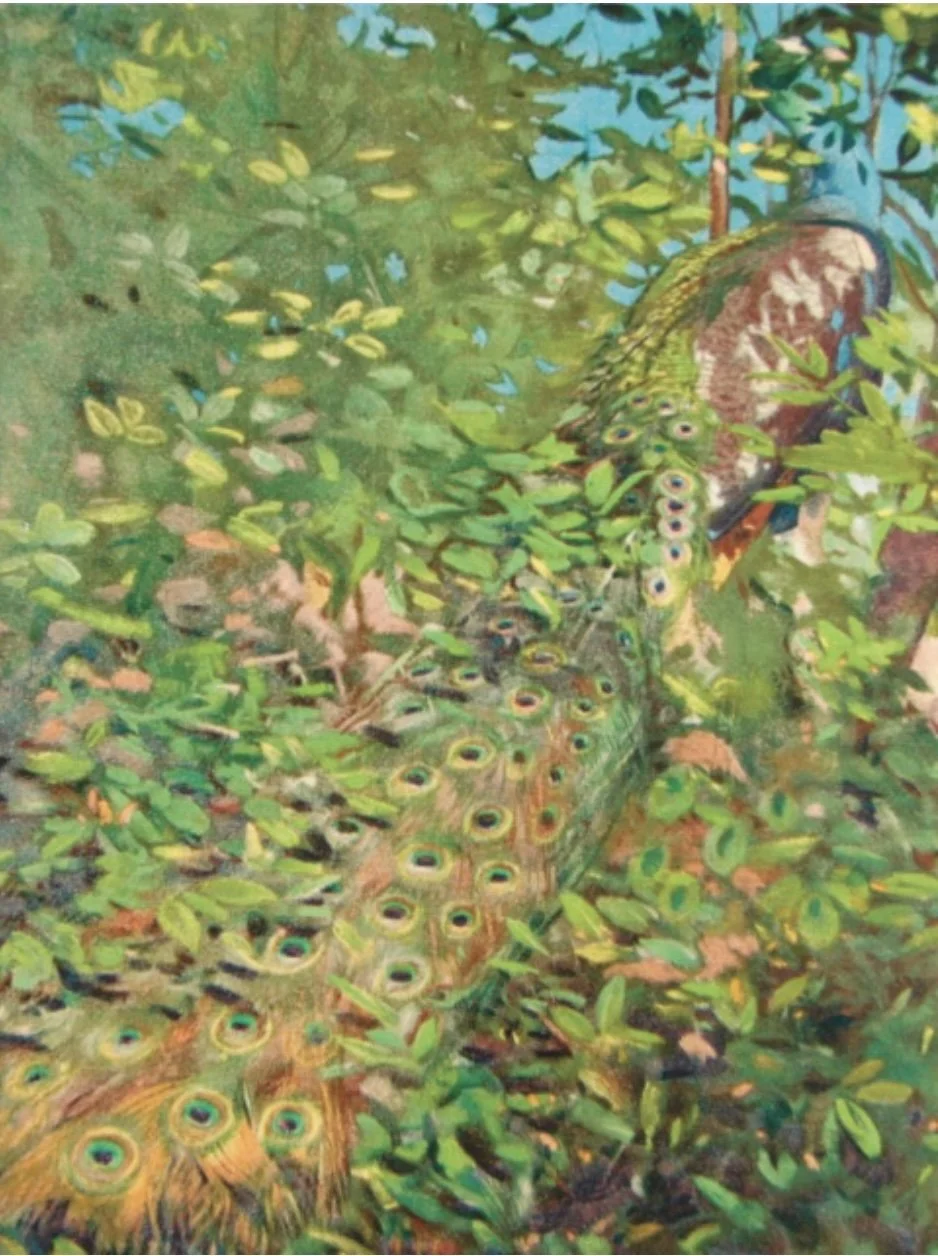
Figure 6.
Thayer plate of a peacock concealed in the forest.
(Gerald Thayer and Abbott Thayer, Concealing-Coloration in the Animal Kingdom (New York: MacMillan, 1909).)
More plausible, perhaps, is his photographic plate of a grouse showing it concealed in its forest environment (Fig. 7).
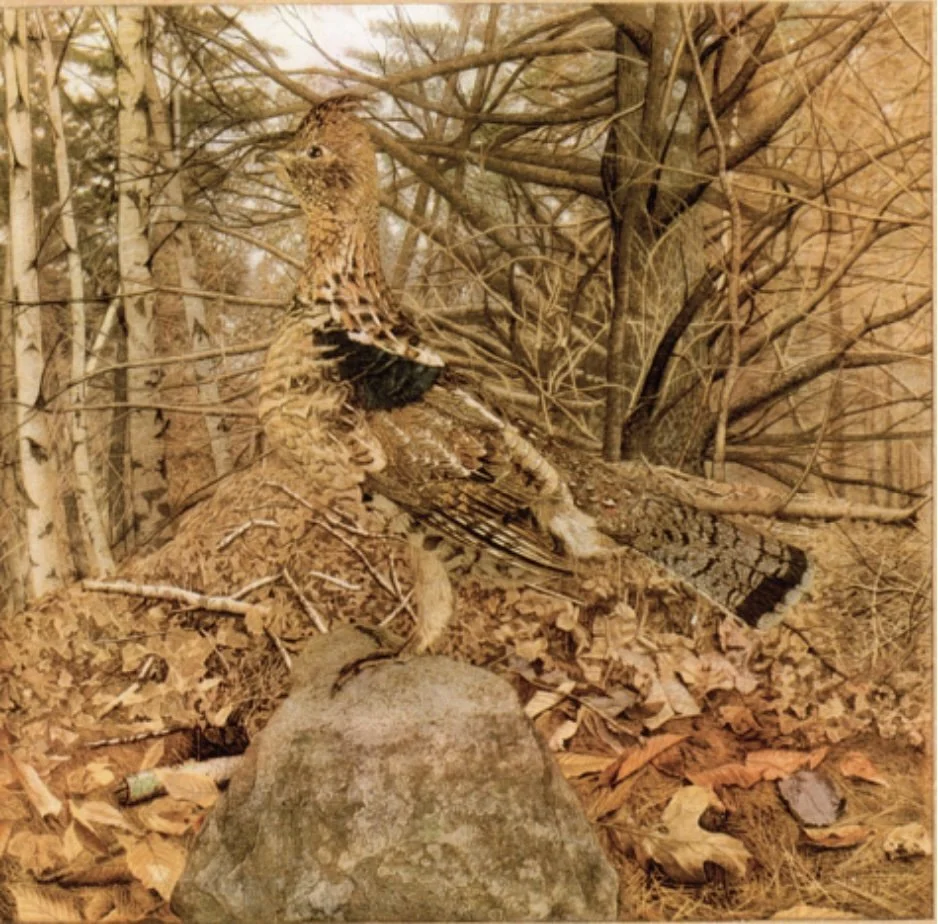
Figure 7.
Thayer plate of a grouse concealed in the woods.
(Gerald Thayer and Abbott Thayer, Concealing-Coloration in the Animal Kingdom (New York: MacMillan, 1909).)
Almost everyone would agree that grouse are well concealed in the forests in which they live. But, Thayer goes further. He tells us that if you want to know what a forest looks like, you should not go around looking at forests because they will confuse you with their idiosyncracies. You should look at animals such as the grouse who must be concealed wherever they are in the forest. Thayer writes:
They are, in the best sense of the word, triumphs of art; and in a sense they are absolute, as human art can never be . . . There he will find it in epitome, painted and perfected by nature herself. Color and pattern, line and shading, all are true beyond the power of man to imitate, or even fully to discern.[19]
It was this insight that led Thayer to become the father of military camouflage. He went around trying to get the U. S. military to adopt the idea. He failed, though the French military took him up on it. Now, of course, military camouflage is well established everywhere.
Under the influence of this book, I was failing to see animals everywhere. Driving in the high plains along Route 285 in New Mexico in the early spring, I would think of Thayer’s claim that antelope are marked so as to be concealed on the patchy background of snow and bare soil.[20] I would be thinking that there were hundreds of antelope out there, but that I could not see any of them. The problem with this construal is that in fact you can see them, especially if you are looking for them.
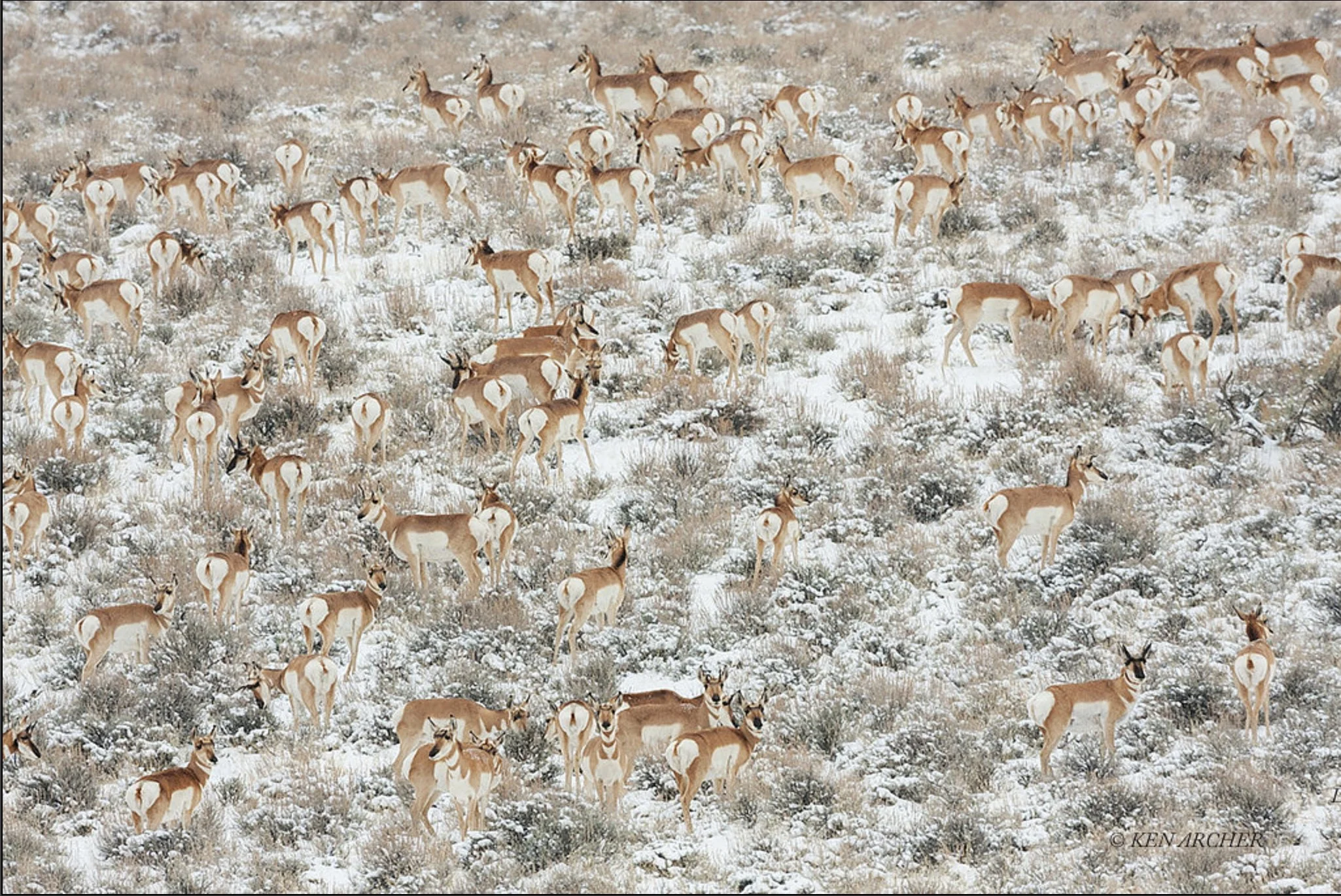
Pronghorn antelope.
Photo by Ken Archer (https://kenarcherphotos.com/p953706307/h46bd5ad7#h46bd5ad7)
One person who read Thayer’s book and was incensed by it was Theodore Roosevelt. In fact, he was so incensed that he published a 120-page rebuttal in the Bulletin of the American Museum of Natural History.[21] Roosevelt writes: “It is impossible to go over page by page the really countless erroneous statements, wild guesses, and absurd interpretations of fact which the book contains.” He cuts the Thayers some slack because of their artistic temperaments, but finds their lack of knowledge inexcusable. As you may know, Roosevelt was famous as a big game hunter and could easily take the point of view of a predator. He was also an excellent naturalist and knew the names and habits of all the small birds and mammals that lived around him. Going back to the frontispiece, Roosevelt points out that if the peacock is indeed concealed in the forest environment, then the peahen—which is very differently colored—must be conspicuous in that environment.
Here is a summary of some of his main objections: First, Roosevelt says that it is our eyes, and not the colors of the animals, that determine whether we will see them. He tells us that his native guides in Africa could often see animals he failed to pick out. Further, cover is more important in concealing animals than their colors, motion is also more important than colors, and besides, most predators hunt by scent and do not use their eyes until they are very close—and by then they already know the animal is there. All these objections have merit. In fact, Roosevelt almost, not quite, but almost, claims that all animals are conspicuously colored, the opposite of the Thayers’ claim.
Before going on I want to relate an incident that happened while I was still very much under the influence of Thayer’s book. I was watching mallard ducks on a pond at sunset with my daughter. The speckled brown females were difficult to see wherever they were— on the bank, in a tree, or in the water. The males, which Thayer claims are concealingly colored in the pond environment, were very easy to see. We were watching a particular male swim across the pond, and at one point it suddenly and completely disappeared.
That is, its white back matched the sparkly white water of the pond at sunset, its brown breast matched the reflection of a tree trunk in the water, and its green head matched the reflection of foliage in the water. It was so startling that I actually jumped. Then, a half-second or a second later, it swam out of that position and again could be easily seen.
So, Thayer is only a little bit right when he claims that male mallards are concealed in their pond environment. For the most part they are not. However, a kind of secret was revealed through this experience. They seem somehow born of their environment. It was as if someone had taken a piece out of a jigsaw puzzle of a pond at sunset and turned it into a male mallard duck.
One more important participant in this debate on animal coloration was John Burroughs, a naturalist and writer from New York state. He published an essay in 1908 entitled “Gay Plumes and Dull.”[22] In it he takes up the topic of concealing coloration. He has his own set of objections to the theory. He points out that if concealing coloration were so important to animal survival, you would expect all animals in a given environment to be the same color, yet we see that they are not. Also, we would expect concealingly colored animals such as grouse to be more abundant than brightly colored animals such as male cardinals and pheasants, and we would expect the females of these last two species to be more abundant than the males. Yet, this is not what we see. From experience I can say that this is also the case with insects. Species with concealing colors are not more numerous as a rule than brightly colored ones.
Burroughs writes:
Whatever truth there may be in this theory of protective coloration, one has only to look about him to discover that it is a matter which Nature does not have very much at heart. She plays fast and loose with it on every hand. Now she seems to set great store by it, the next moment she discards it entirely.[23]
Burroughs accounts for the colors of the antelope and other animals like this:
Things in nature blend and harmonize. One thing matches with another. . . . Arctic life will blend more or less with Arctic snows, tree animals will show greater variety in tint and form, plains animals will be dull of hue like the plains . . . through the law of natural assimilation, like begetting like, variety breeding variety.[24]
He reaches for a “law of natural assimilation” to explain this, and also reaches for another natural law to explain differences in coloration between males and females of the same species:
His gay plumes are the badge of his masculinity . . . the riot and overflow of the male sexual principle.[25]
Females being generally more dull in hue partake in a more passive female principle of nature. Burroughs still feels that the appearances have not been fully accounted for. He goes further, speculating that:
It is like the caprice of fashion . . . exaggerated plumes, fantastic colors, and monstrous beaks of many birds in both hemispheres have as little apparent utility, and seem to be quite as much the result of caprice, as are any of the extreme fashions in dress among human beings. [26]
Even in the animal world, there is fashion. One man who takes up this theme, decades later, is Roger Caillois, a French philosopher who published a book in 1964 entitled The Mask of Medusa.[27] Caillois was especially interested in the phenomenon of mimicry in the insect world. The dead leaf butterfly is a good example.[28] The undersides of the wings are a perfect mimic of a dead leaf, complete with leaf veins, fungal spots, and a broken stem. If this butterfly was immobile in leaves on a forest floor, you would never see it. However, it is not uncommon to see these insects outside of the environment where they would be concealed, as if they are, perhaps, showing off.
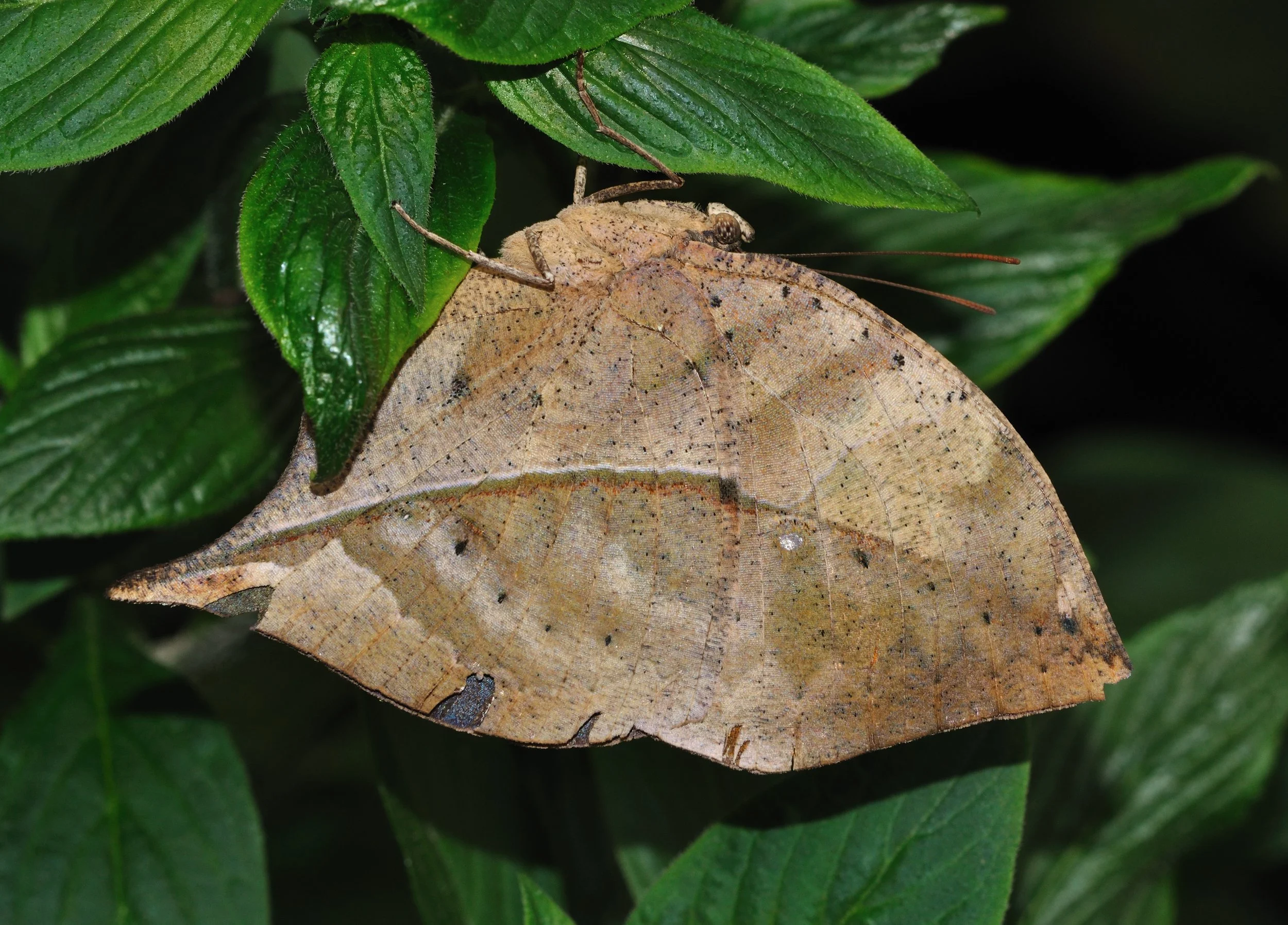
Kallima Inachus.
By Quartl - Own work, CC BY-SA 3.0, https://commons.wikimedia.org/w/index.php?curid=16038903. (https://en.wikipedia.org/wiki/Kallima_inachus)
Another spectacular mimetic caterpillar is Hemeroplanes triptolemus, found in Central America.[29] It looks like a regular caterpillar when it is feeding on a branch. However, in the last stage before it pupates, if disturbed, it turns upside down and comes at you looking for all the world like a tree viper, though the “eyes” are not real and cannot see. The theory is that birds or other predators think they are in the presence of an animal that is dangerous to them and are frightened away, instead of eating the caterpillar. It is thought that any caterpillar that deviates from the perfect mimetic form will be spotted and eaten by predators until, eventually, the most perfect mimics are “created” by this selective predation.
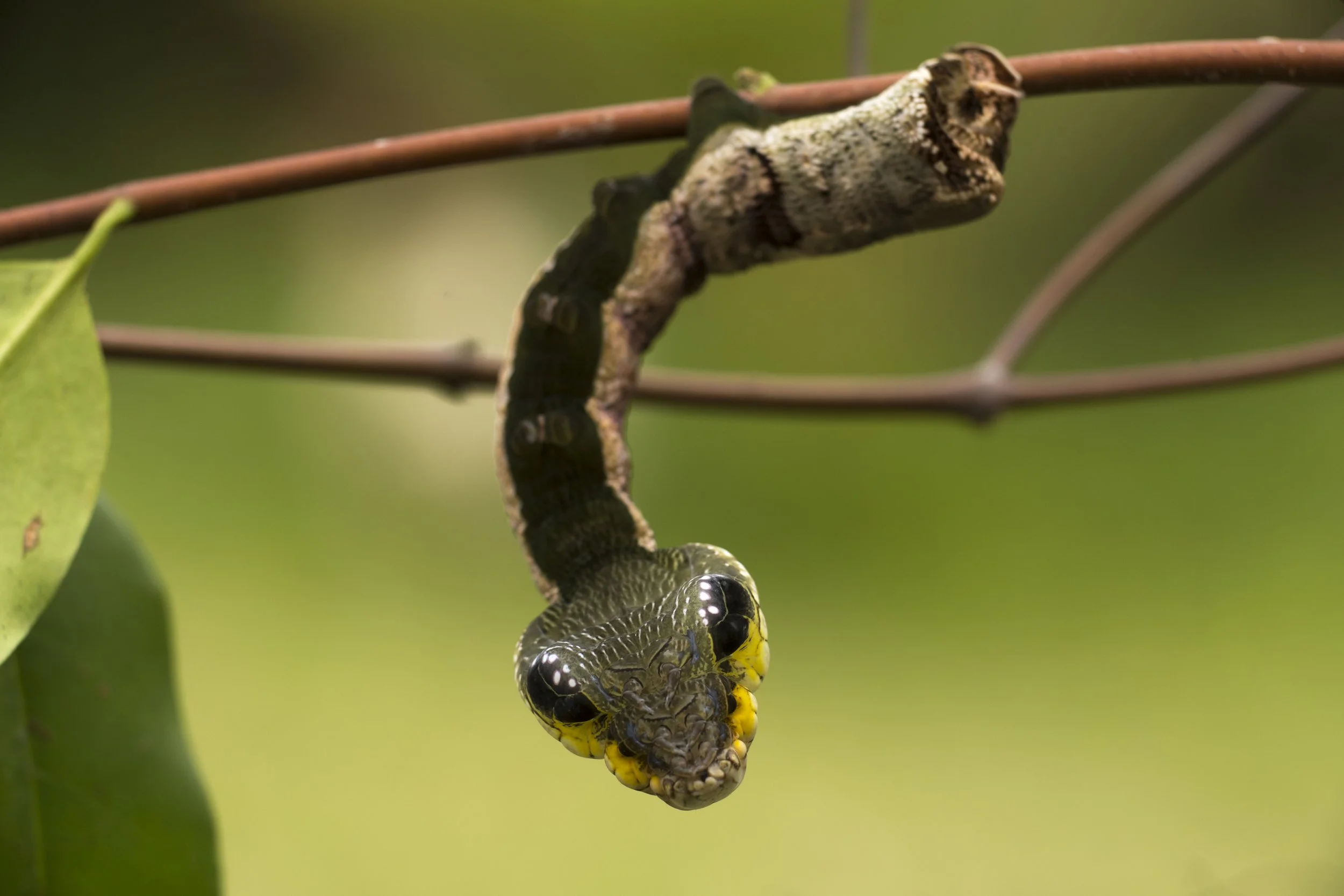
Hemeroplanes triptolemus.
Many butterflies and moths are known as snake mimics. The spicebush swallowtail, native to the United States, is one such caterpillar.[30]
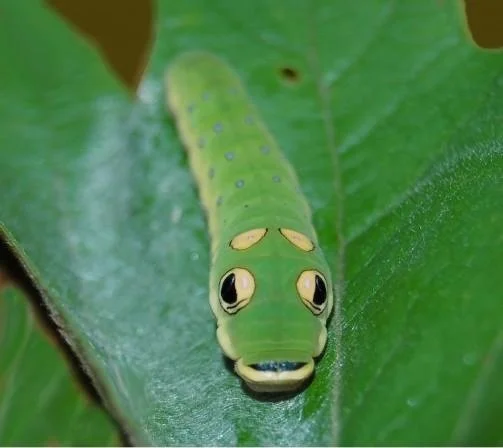
Spicebush swallowtail caterpillar.
Photo by J. R. Baker. (https://content.ces.ncsu.edu/spicebush-swallowtail)
To me, this caterpillar looks more like a friendly stuffed toy snake than a dangerous enemy. We need to wonder why it is that the first mimic is so perfect if this second one is an effective deterrent of predation. Adults may also be identified as snake mimics. Philip Howse, of Southampton University in England claims that the wing of the atlas moth is a cobra mimic.[31] Look at a whole atlas moth.[32]
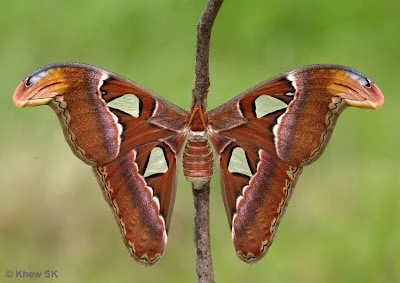
Again, we are led to wonder why, if birds are such astute and perceptive predators, they don’t know that cobras are five feet long and live in the rice paddies, not five inches long and hanging in the air.
Caillois notes this “aimless delirium of perfection in nature,” and proposes that mimicry is an autonomous force in the world of biology that does not require utilitarian explanations. He goes further and also invokes, like Burroughs, a principle of fashion, connecting it with the phenomenon of mimicry:
But in the case of man, fashion is also a phenomenon of mimicry, of an obscure contagion of fascination with a model which is imitated for no real reason.[33]
The plant hoppers are a group of sap-sucking insects that live on trees and shrubs. They have an astounding variety of forms.[34] They may resemble wasps as one of the photos on the foregoing site sort of does. You can see the black and white stripes, the narrow “wasp waist,” and a variety of pointed projections that may deter a predator. Notice that the real body is underneath the wings. The whole “wasp” is a projection of the prothoracic segment. It is as if the plant hopper is wearing a mask or a costume. If we look at other plant hoppers, we will be impressed that many do not seem to be mimics at all. Their colors, shapes, and ornaments seem more like the work of a playful, creative imagination.
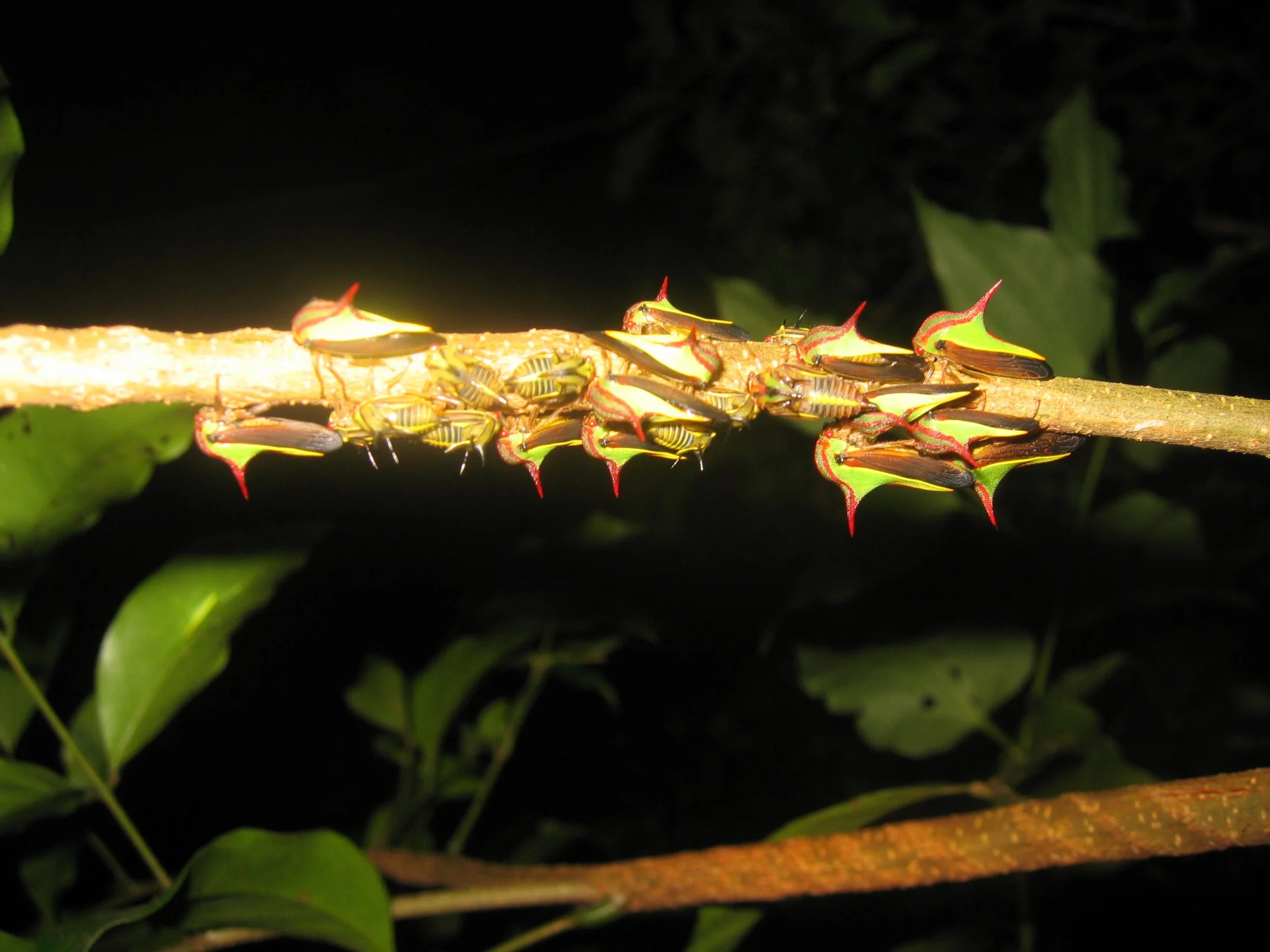
Treehopper.
Dirk van der Made, CC BY-SA 2.5 <https://creativecommons.org/licenses/by-sa/2.5>, via Wikimedia Commons; (https://en.wikipedia.org/wiki/Treehopper)
So far, I have been referring to art as something like “the beautiful.” Now we are seeing, in the natural world, a different category of art, that of mask and costume, a category that has a wide variety of functions in the human world. Caillois was especially interested in an insect called the lantern bug (Fig. 8). They are related to the tree hoppers and also live by sucking sap from trees.
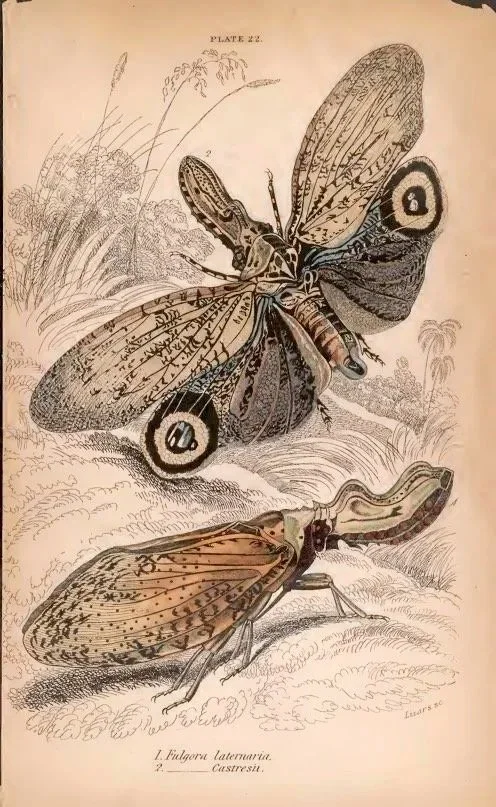
Figure 8. Lantern Bug.
From James Duncan, Introduction to Entomology, Vol. 1 [Vol. 30 of The Naturalist’s Library, ed. Sir William Jardine] (Edinburgh: W. H. Lizars, 1840), Plate 22.78
It is a Swiss army knife of a bug; the forewings mimic dead leaves, when they are lifted up there are two prominent eye spots. These are generally interpreted as looking like vertebrate eyes so that a potential predator, thinking it is in the presence of a larger predator that could be a danger to it, will be frightened away. Best of all, it has a large alligator mask above its real head. You can see the eyes, the nostrils, and the row of teeth. Again, we must question. Don’t the predators know that alligators are six feet long and live in the river, rather than an inch or so long and in a tree?
Caillois compares the lantern bug to a human shaman. The dead leaf forewings are its cloak of invisibility which can be suddenly thrown off to reveal the conscious being who had been hidden. He writes:
Where there was nothing, there is suddenly horror. The insect knows how to frighten; what is more it gives rise to a particular kind of fear, an imaginary terror not corresponding to any real danger . . . working through the strange and fantastic.[36]
One further example of this phenomenon is the oleander hawk-moth caterpillar, Daphnis nerii.[37] This caterpillar, when viewed from a certain angle, exhibits creepy glowing eyes that do not look like those of any animal, but evoke horror. They have the same kind of effect as eyes painted on a shield or the bow of a ship. This suggests that birds, monkeys and other predators may be susceptible to a kind of existential dread brought on by these false, staring eyes.
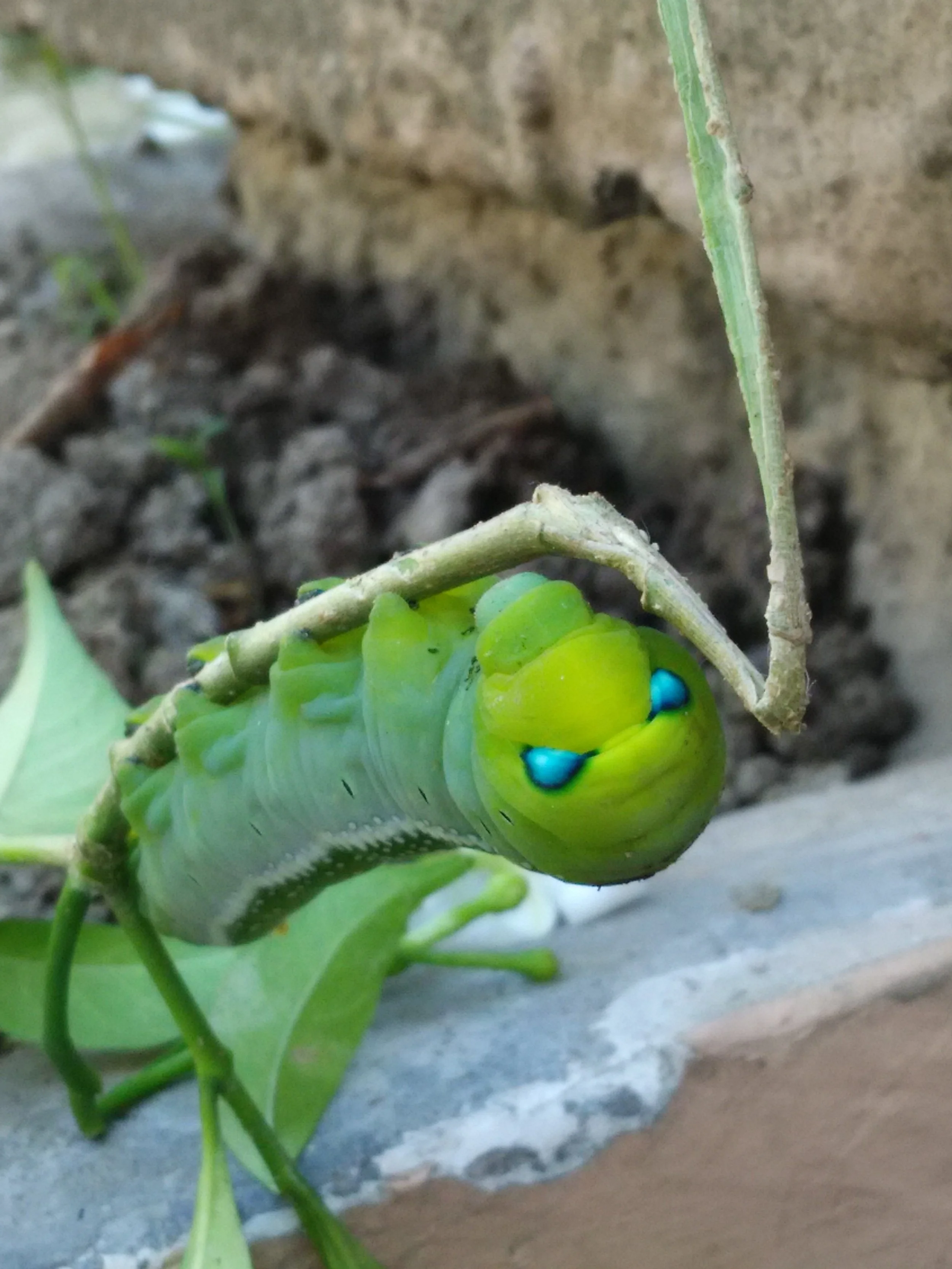
Oleander hawk-moth caterpillar
Sumita Roy Dutta, CC BY-SA 4.0 <https://creativecommons.org/licenses/by-sa/4.0>, via Wikimedia Commons (https://commons.wikimedia.org/wiki/File:Oleander_Hawk-moth_or_Army_Green_Moth_Caterpillar_at_Behala_Kolkata.jpg)
The wide range of such costume- and mask-effects in insects mirrors the many uses of masks in human communities. There are masks to disguise, to camoflage, to frighten, to take on the look and energies of another kind of creature—there are even masks just for play. If we go with Caillois’s thought, we can see that humans are not isolated from the rest of the natural world by our art, our mythology, our psychology. We belong to the world and can see aspects of these human features represented in the behavior, or printed on the actual anatomy, of other animals.
I have been arguing that there is more going on in the world of biology than natural selection for the purposes of survival and reproduction. Especially today, when most thinking about evolution is connected with thinking about genes, we confine ourselves to a narrow range of interpretation of biological phenomena. As a result, we are continually underestimating the capacities of animals, and this underestimation takes place before there are any data. We are always tempted to read the capacities of animals off of their genes or anatomy and from the theory of natural selection. No matter how many times this is shown to be wrong-headed, these strategies are constantly invoked. Truly, it is not possible to know what an animal is capable of without actually observing its behavior for a long time under a variety of circumstances.
It is assumed that bees have such tiny brains that they cannot do symbolic reasoning, but showing that they do somehow does not challenge the general principle. When we limit beforehand what we believe is possible, we often cannot see what is right in front of our eyes, or we fail to reflect about it at all because we have already sorted out the observed appearance or behavior into one of our preset categories. One thing is warning coloration, another is sexual selection, another is protective coloration—and we’re done. Not only do we fail to see, we lose a language that is adequate to the actual phenomena. We lose a sense of Nature with a capital “N,” a nature rife with potentiality and surprises, Nature as a principle of motion and change. Only the poets still use this sort of language with a good conscience.
I’ve been using the lens of artistic expression in animals as a way to explore this issue. Here at the end, in the coda, I would like to switch to a different sort of example to illustrate this point. A few years ago there showed up on YouTube some footage of an elk, named Shooter, at the Pocatello Zoo in Idaho, saving a marmot from drowning in a water tank. There were two witnesses, a veterinarian and an educator. The whole event took about 15 minutes. The elk was pawing at the water and with his big unwieldy antlers, trying to get his head in the tank. Finally he lifted out the marmot, put it on the ground, and gently nudged it with his foot. In a little while the marmot shook itself and ran into its hole. It is wonderful footage.[39]
The odd thing to me was the narrative of the witnesses. Even as we are watching, they are explaining that elk don’t do this. They are all about survival. They speculate that it is only because Shooter lives in a zoo and has his needs met that he can develop more elaborate behavior. The scientist in me immediately asks how we know that elk don’t do this. Do we have dozens of examples of marmots squeaking in distress as they drown in mountain lakes while elk graze unconcernedly on the shore? We don’t really know as we only have one example of an elk confronted with this situation. Underlying the narrative is the view that elk behavior is generic and aimed only toward survival. I suggest that the elk and the marmot, who after all live in the exact same place, know each other. This may be an act of individual friendship, not calling for any explanation at all in terms of natural selection.
I hope I have stimulated you to look more carefully and think more widely when you observe animals. The world of animal appearance and behavior is wide and wonderful. The next step is for you to go outside and start looking around for yourself.
Linda Wiener (1957-2020) was a Tutor at St. John’s College in Santa Fe, New Mexico. This paper is adapted from a lecture delivered at the College’s Annapolis campus on September 6, 2013. It was originally published in The St. John's Review, volume 55, number 2 (Spring, 2014). Hyperlinks have been updated or replaced when necessary.
Notes
[1] Charles Darwin, On the Origin of Species, first edition (Boston: Harvard University Press, 2001.)
[2] David Rothenberg, Why Birds Sing (New York: Basic Books, 2005).
[6] Charles Darwin, Descent of Man and Selection in Relation to Sex (New York: Penguin, 2004)
[7] Noel Perrin, Second Person Rural (Boston: David R. Godine, 1980).
[8] Douglas Chadwick, The Wolverine Way (Ventura, California: Patagonia Books; 2010).
[12] David Rothenberg, Survival of the Beautiful: Art, Science, and Evolution (New York: Bloomsbury Press, 2011).
[13] Jo Whaley, Deborah Klochko, and Linda Wiener, The Theater of Insects (San Francisco: Chronicle Books, 2008).
[16] https://en.wikipedia.org/wiki/File:Multi-Modal-Courtship-in-the-Peacock-Spider-Maratus-volans-(O.P.-Cambridge-1874)-pone.0025390.s001.ogv
[18] Gerald Thayer and Abbott Thayer, Concealing-Coloration in the Animal Kingdom (New York: MacMillan, 1909).
[19] Thayer, 240.
[21] Theodore Roosevelt, "Revealing and Concealing Coloration in Birds and Mammals,” Bulletin of the American Museum of Natural History 30 (1911):119-239.
[22] John Burroughs, “Gay Plumes and Dull,” in Leaf and Tendril (New York: Houghton Mifflin, 1908).
[23] Burroughs, Leaf and Tendril, 61
[24] Ibid., 80.
[25] Ibid., 95.
[26] Ibid., 90.
[27] Roger Caillois, The Mask of Medusa, tr. George Ordish (New York: C. N. Potter, 1964).
[31] https://www.telegraph.co.uk/news/earth/wildlife/8082739/Butterflies-and-moths-mimic-snakes-and-foxes-to-fool-predators-claims-researcher.html
[33] Caillois, The Mask of Medusa, 41.
[35] James Duncan, Introduction to Entomology, Vol. 1 [Vol. 30 of The Naturalist’s Library, ed. Sir William Jardine] (Edinburgh: W. H. Lizars, 1840), Plate 22.78
[36] Caillois, The Mask of Medusa, 104.
[37] See below and http://www.flickr.com/photos/77995220@N00/9398097107
[39] Original news article here: https://abc7.com/archive/8211416/