The Horses of Achilles
Robert C. Abbott, Jr.
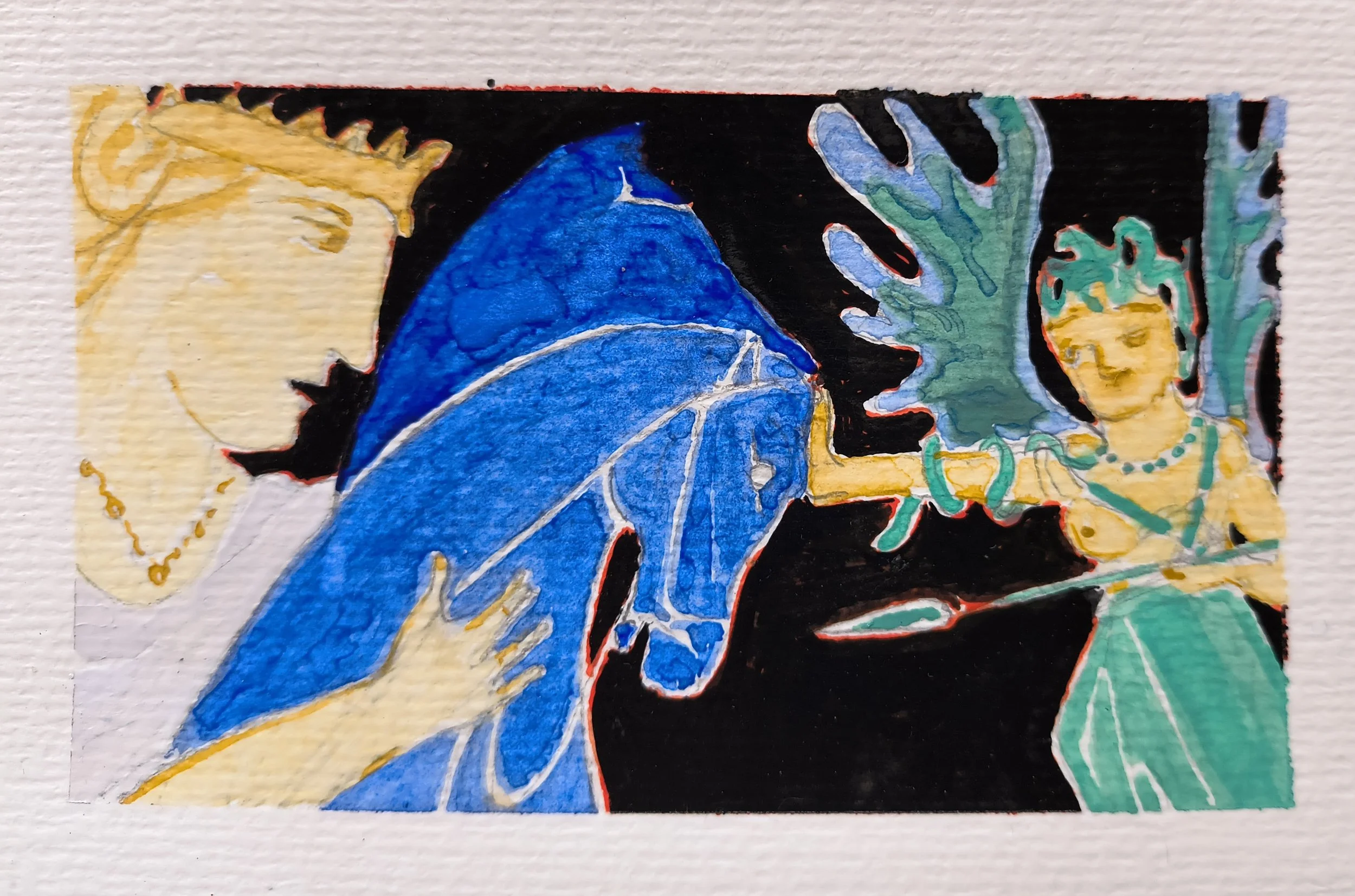
At the end of the Nineteenth Book of the Iliad, Achilles prepares himself to return to the battlefield and avenge the death of his friend, Patroclus. He puts on the divinely wrought armor of Hephaestus, mounts the chariot behind his two immortal horses, and calls on them in a terrible voice:
Xanthos, Balios, Bay and Dapple, famed sons of Podarge,
take care to bring in another way your charioteer back
to the company of the Danaäns, when we give over fighting,
not leave him to lie fallen there, as you did to Patroklos.[1]
(XIX.400-403)
As if to countermand this insult, the goddess Hera then gives one of the horses a prodigious, unheard of gift: the power to speak and reply to Achilles. Xanthos claims he and his brother, Balios, were not to blame for the death of Patroclus, and though they will bring Achilles safely home, his death is not far off. After he is finished speaking, the Furies take back Xanthos’ voice as quickly as it was given. Achilles is deeply shaken by the ominous speech, but drives the chariot on.
Xanthos never speaks before this, nor does he or any other animal in the Iliad ever do so again. I would like to understand the significance of this uncanny suspension in the order of the cosmos. Why did Achilles speak to his horse? Why did Hera give the horse the power to reply? What does it mean to speak? In order to answer these questions, we must acquaint ourselves with the nature of those horses who participated in the Trojan War and the deathless horses of Achilles in particular. Not being an expert in horsemanship myself, I will call in others to guide us, among them, Xenophon, the horse trainer and friend of Socrates.
Part One: The Horses
The horses of the Iliad, unlike the dogs who lurk at its edges, are full participants in the war. Just like human warriors, they are sensitive to boredom, terror, and honor. As an example of the first, after the Trojans have taken the field, and their campfires are scattered across it, innumerable and brilliant as the stars, their horses watch through the endless hours of night for the return of dawn, just as their masters do (VIII.564). Horses can be more or less used to war, as when the newly arrived Thracian horses are too frightened to walk on the dead bodies of their masters. And horses, like men, are capable of overcoming even great weariness and reluctance when adequately persuaded. Antilochus calls on his horses during the chariot race at the end of the poem with a rhetorical sophistication we might think appropriate only for human listeners, though he demonstrates thereby the close bond between a warrior and his horses, and their sensitivity to honor (XXIII.400).
A fast horse is life. As it did for Nestor, a chariot can rescue the exhausted hero and carry him to safety (VIII.85). It can also take him where he is needed most. From the height of the chariot a spear can be thrown or a comrade spotted (IV.306). Not to have one’s horses nearby can mean death, as it did for Agastrophos, whom Homer calls a fool for leaving his chariot team with a henchman (XI.340). The horses of Achilles are the high price Dolon demands for his dangerous night raid into the Greek camp (X.320). He does not win them, and the book ends instead with Odysseus and Diomedes capturing the horses of King Rhesus. This strategically unimportant and morally questionable journey into a dark underworld attempts to retrieve something as valuable as the daylight—hope for the successful outcome of the war. And the snow-white horses are symbols of this hope. It is as if their theft secures the sunrise, and the book ends with the bloody, triumphant heroes bathing in the dawn-drenched waters of the sea.
The story of Achilles’ famous horses begins with his father, Peleus. They were a gift from Poseidon, and Peleus gave them to Achilles when he sailed for Troy. Their father is Zephyrus—the West Wind, and their mother, Podarge—a harpy (XVI.148). The harpies, or more literally, “Snatchers,” are winged spirits of the storm, blamed for sudden or unexplained disappearances. Zephyrus by contrast, is the obliging wind who comes at Achilles’ call to kindle the funeral pyre of Patroclus. As with many mythological pairings, these progenitors are opposites: Zephyrus generously comes from afar to help hide the body of Patrocles in fire, Podarge makes mortals disappear with ill will. The horses are as swift as their parents, though their names do not reveal this extraordinary inheritance. Xanthos and Balios refer simply to the color of their coats.
But Achilles has three horses, not two. The third horse, Pedasos, is mortal, and his name is revealing. Janko's commentary suggests that his name may come from the the verb πηδάω, which means, to leap or bound.[2] One can also hear in his name an echo of the verb πεδάω, to bind or to restrain, whose aorist form πεδησα appears twice in the Iliad (XIII.435, XXIII.585). Both these meanings are revelatory of his dual nature: he is bound to the earth by his mortality, but he rises above his natural station to run with the immortal horses. When Pedasos is killed by a spear which pierces his shoulder, Automedon hurriedly cuts him free from the chariot in the chaos of battle. His is a harbinger of Patroclus’ own death, a mortal severed from godlike Achilles. When Pedasos dies, he screams, and just like any of the other heroes in the Iliad, blows his life’s breath from his mouth.
No horse can be handled without skill, but the immortal horses require an altogether formidable rider. Just as a great hero like Achilles is jealous of his freedom to act as he sees fit, inflexibly proud of his peerless excellence, and easily offended by discourtesy, there is something correspondingly perilous in the temperaments of Xanthos and Balios. Odysseus and Apollo agree that they are, “difficult horses to ride,” –certainly an understatement (X.401, XVII.76). Being difficult is not the same as being wild or unbroken. A certain kind of horse might well refuse to be ridden by an inferior rider, just as a certain kind of person might refuse to be commanded by an inferior king.
There are other similarities between Achilles and his horses besides their prideful unwillingness to be led by any but the most excellent leader. Both are accounted in the catalogue of ships to be the best among the Greeks (II.770). When Achilles finally returns to the field of battle, he attains the cosmic proportions this duel ranking promised: his eyes burn like fire, he shines like the madness-inducing Dog Star, his shield depicts the entire earth, and he is drawn by immortal horses, swift as the wind. By this time in the poem, Pedasos and Patroclus are dead; nothing remains to remind him of his human heritage, only Xanthos’ prophecy of his imminent death. But the likeness between Achilles and the immortal horses is in no way better exemplified than at the funerary games for Patroclus. Neither participates; they stand apart and mourn.
Part Two: The Charioteer
The immortal horses are more difficult to ride than any other, though it is to Patroclus, not Achilles, their mastery belongs (XVII.475). He is their beloved charioteer (ἡνίοχος), a word which applies peculiarly to him, the greatest charioteer for the greatest warrior (XXIII.280). Achilles, while watching the funeral games, remembers him this way:
But I stay here at the side, and my single-foot horses stay with me;
such is the high glory of the charioteer they have lost,
the gentle one, who so many times anointed their manes with
soft olive oil, after he had washed them in shining water.
As Pandaros says to Aeneas, horses carry better the horseman they know best (V.230). “To know” in this sense entails profound trust and understanding. He goes on to say that it is the longed for voice of the charioteer that calms the terror battle brings on, not the rider’s skill with the mechanical apparatus of the chariot.
Hector speaks to his horses with this same intent to calm and encourage. He asks that they repay in battle all the care his wife, Andromache, gave them in peace (VIII.185). There is a likeness between Hector’s speech and Achilles’ insult: Hector demands his horses repay the special kindness Andromache showed them, just as Achilles accuses his horses of unjustly not repaying the kindness of Patroclus. In both addresses Patroclus and Andromache are the horses’ special caretakers whose memory should inspire them to excellence. This is not the only time Patroclus has been implicitly compared to a woman.
In Book Nine, Phoenix tells Achilles an only apparently rambling story meant to convince him to return to the battle before the Greeks are driven into the sea. It becomes clear he is not primarily addressing Achilles. Patroclus’ name means “glory of the father,” and the wife of the angry, recalcitrant hero in Phoenix’s story is Cleopatra, its feminine equivalent. In the story, Cleopatra is the only person who can persuade her husband, Meleager, to give up his anger and save the city, just as Patroclus might be the only person who can convince Achilles to save the Greeks. Gentle and masterful charioteer that he is, he might be able to persuade spirited Achilles, just as Cleopatra did her husband.
The epithet with which Achilles addresses Patroclus after he has agreed to let him go into battle is ἱπποκέλευθος. This word is used only three times in the Iliad and exclusively to characterize Patroclus. It distinguishes his horsemanship from the Trojans’ who are often referred to as ἱπποδάμοιων, “breakers of horses.” Ἱππόδαμος is derived from the word for horse, ἳππος, and the verb δαμάζω, which means “to break in, tame; (in mid.) to control (horses); to bring into subjection (political or matrimonial); to wear out or exhaust; to curb or restrain; to overcome, overpower, to put an end to, to destroy.”[3] Although the lexicon suggests this wide-ranging word means something like “bring into order” when it refers to horses, in its broader sense it hints at the forceful means by which this is accomplished, as well as the permanent circumstances which ensure the obedience of the horse. The Trojans have their horses under control, but rather in the way Xerxes controls his army—always under threat of the lash.
Patroclus’ epithet, ἱπποκέλευθος on the other hand, has a very different range of meaning. Its root appears to be κέλευθος, which means “way, road, or path,” and so one Homeric lexicon defines ἱπποκέλευθος as “one who fares with horses,” while another suggests, “making the road on a chariot, chariot-fighter.”[4] Lattimore translates it as “rider of horses,” and “lord of horses,” the latter of which nicely captures a verbal echo from the verb κελεῦω, which has the primary meaning, “to command persons, order, bid, enjoin, give orders or injunctions.” Secondarily, it means “to bid, exhort, charge, urge, recommend, counsel, invite.” These two resonances in his epithet—κέλευθος and κελεῦω—imply that Patroclus’ relationship to horses is not one of breaking them to his will, but rather, of commanding them, as one might command a fellow warrior capable of understanding and assent. In his horsemanship, the horse is taken to be a thinking being capable of persuasion. Patroclus is ἱπποκέλευθος because he follows the way of the horse.
I will now turn to Xenophon and a few other horse trainers to show that this difference—between force and persuasion—is a fundamental concept in horse training, and that anyone who would fare with horses must make a decision regarding it. The distinction reaches to the depths of the conflict portrayed in the Iliad.
While Xenophon recommends many means of training the horse one might call forceful, he is very clear: the final end of horsemanship is for the horse to act in all ways of its own free will. He means this to be true most of all when the horse is asked to do more dangerous things than it would ever do in the wild. This is a simple but difficult thought to accept. How can a rider ride a horse unless it is the rider’s will which rules? Here is Xenophon’s answer.
For what a horse does under constraint, […] he does without understanding, and with no more grace than a dancer would show if he was whipped and goaded. Under such treatment horse and man alike will do much more that is ugly than graceful. No, a horse must make the most graceful and brilliant appearance in all respects of his own will… (The Art of Horsemanship XI.4) [5]
A more modern inheritor of Xenophon’s tradition writes, “The thing you are trying to help the horse do is to use his own mind. You are trying to present something and then let him figure out how to get there.” That is the trainer Tom Dorrance on horsemanship, or, perhaps, on education generally. Dorrance also talks about those riders who don’t “get in the way of” their horse. [6] According to these teachers, true horsemanship is not forcing the horse to act, but rather, allowing the horse to do what he or she is capable of and wills for itself. “You need to be the horse’s master, but him not the slave, but rather your willing partner.”[7] He sums up the relationship between horse and rider as a “true unity of willing communication,” and later, to be clear he is not describing a monstrous melding of horse and man in which the individuality of each is lost, he calls this state of mutually dependent unity, “togetherness.”[8]
We can properly estimate the horsemanship of Patroclus by noting what it enables him to do with the horses. It is not always true that actions are revelatory of the powers which enable them; mere force can induce great and terrible effects all on its own. But in this case, the action in question is so extraordinary that we can look to it as a true marker of his skill. In order to understand its significance, we must remember the precarious situation the Greeks find themselves in without Achilles—exhausted, with their backs to the sea. Nestor proposes a plan to make up for his absence. First, they will gather and bury their dead in a collective funeral pyre. Then they will construct a wall, fronted by a moat, lined with wooden stakes meant to impede and impale the expected Trojan assault. This construction will transform the Greeks’ piratical encampment into a more permanently defensible fort, but also anchor them even more firmly in a defensive position. The buried warriors are meant to protect them from their enemies just as much as the wall and moat (VII.327). One might recall the body of Oedipus buried at Colonus to defend Athens from invasion, or the Spartan theft of Orestes’ bones to ensure their conquest of Arcadia (Herodotus, History I.67).
The Greek encampment is founded on and preoccupied with the dead, the dark, and past grievances. It is the city of heroes and of Hera. Troy is the city of life, and the forgetful forgiveness of Paris’ calamitous theft of Helen. It is the city of lovers and of Apollo. In the twilight between Greek darkness and Trojan light lies the plain of war, the place of heroic action.
When Patroclus finally rides out in defense of his comrades, he turns the tide of the battle and drives the Trojan flood back into this plain. Many are crushed in the panicked retreat or trapped in the dust-choked ditch. Patroclus drives the horses straight towards this grisly chasm, heedless of the danger, and vaults it in one death-defying spring (XVI.380). Xenophon says in The Cavalry Commander, if it is true a man should wish to fly, then he should learn to ride a horse, as it is that activity which most closely resembles it (viii.6). This astonishing physical feat is itself only a mark of an even greater spiritual one. The leap of Patroclus affirms that though human life may only be safe behind a barrier founded on the memory of those who have gone before us, it is possible to leap into the living present and act for ourselves. While the leap shows us what Patroclus and the horses were capable of, their reaction to his death reveals the great love which made it possible.
Part Three: The Grave
After the horses hear that Patroclus is dead, Homer says that they stand still and weep. The verb (πυθέσθην, from πεύθομαι, XVII.427) emphasizes that they do not simply witness, but hear of and understand what has happened. Patroclus’ death is described elliptically. He falls “in the dust,” (ἐν κονίῃσι) and the horses mimic his collapse by trailing the full length of their manes in the muck of the battlefield. Their self-desecration anticipates the fate of his dead body, soon to be returned to the earth. The horses bow their heads, let their tears flow to the ground, and in one of the most arresting similes of the poem they stand, “fixed (ἔμπεδον) as a gravestone.” Ἔμπεδον recalls the name Pedasos, the mortal horse whose name means “fettered,” or as we might hear it now, “earthbound.” Without Patroclus to guide them, the immortal horses are rooted to the earth, like their dead comrade.
The horses are compared to a gravestone not only because they are still, but because their immobility means something, in the way a gravestone means the presence of a body. It means they have lost, or are willing to give up, that essential part of themselves—their speed—out of love for Patroclus. Rather than run away from his death, in body or in mind, they remain with him.
The word for remain here, μένει, might remind us of the link Socrates makes between “remaining” and “remembering” in the Meno. The heroes of the Iliad long for immortality in the form of undying fame and they fear forgetful oblivion. When the carnage Achilles wreaks is so great the river Scamander rises from his bed in indignation, Achilles fears not only that he will drown, but that he will be forgotten in the depths without a fixed grave marker to remember him by (XXI.315). Patroclus will not be so forgotten. Homer’s simile makes the horses’ eloquent immobility his memorial.
Homer notes that the grave in the simile is for either a lord or a lady. This seemingly inexplicable addition suggests the horses mourn Patroclus as if he were both man and woman, which is appropriate, given his dual nature. On the one hand, he is the horses’ gentle charioteer, he sets the bread on the table when the embassy comes to persuade Achilles, he comforts Briseis when she is first brought to the Greek camp, and he is compared to Andromache and Kleopatra. On the other, he is a great warrior, eager for glory, the best of the Myrmidons. He kills more warriors in the field than anyone else in the poem, more than Achilles and Hector combined. The grave of Patroclus is the grave of all mankind, without regard for gender.
One might think after hearing their careless laughter at the end of Book One that the immortals have no cause to mourn, but we see this is not so. Zeus himself weeps tears of blood when his son Sarpedon dies, and the mourning of the horses gives the king of the gods another occasion to contemplate the sorrow of immortality (XVI.459). When he sees the horses grieving, he asks himself: why did we give you to a mortal man, the most wretched creature on earth? The mourning of the immortal horses shows that they were not made to serve a mortal unwillingly, as Poseidon and Apollo served King Laomedon in building the walls of Troy (VII.445). Rather, the horses mourn Patroclus for the same reason Zeus mourned Sarpedon: they have lost he whom they loved.
The horses refuse to leave Patroclus’ body. Automedon uses every kind of persuasion: he beats them, he threatens them with a sharp whip, and he pleads with them.
Their refusal is both evidence of their love as well as an indication that the bond which tied them to Patroclus does not yet extend to Automedon. The epithet ἱπποκέλευθος implied that the horsemanship of Patroclus depended on persuasion and willing assent. Without it, the horses are not moved by words, either threatening or pleasing, nor can they be forced from their place. Their power cannot be harnessed by a mere breaker of horses.
Hector notices the famous team standing by the body of Patroclus and hopes to add them to the spoil of Achilles’ armor. Zeus emphatically denies him this. Rather than force them to return to the ships, he puts great strength into their knees so that they are themselves able to overcome their grief. When Xanthus and his brother later stand accused of desertion, he does not tell Achilles it was Zeus who aided them or that their first reaction to his death was to stay and weep for Patroclus. But we know that the true reason they left the battlefield was because Zeus gave them the strength to, just as we know that the true cause of their staying was their love for Patroclus.
Part Four: Justice
We are now in a position to appreciate the depth of Achilles’ insult I began by describing. His scornful request that the horses make sure to return him safely as they did not do for Patroclus insinuates, that when Patroclus needed them most, they failed in their trust. It is as if Achilles sees in their desertion a bitter reminder of his own abandonment of the army. Without Patroclus, Achilles does not believe in the willing compliance of the horses, or his power to persuade them. His command is undermined by its irony: if the horses abandoned Patroclus, why should they not abandon him as well?
The seriousness of his insult catches the attention of an equally serious power in the cosmos. That it is the queen of the gods who gives Xanthos the power to speak marks this occasion as significant in more than the world of horsemanship. Whenever a god acts in the way Hera does here, their sphere of responsibility has been violated, and a god always and tirelessly protects that for which it is responsible. Hera gives Xanthos the power to speak so he can correct Achilles’ unjust insult. Why this should be any of her concern is made clearer by looking to the sorts of things that move her to anger and to action.
Hera is the last word of Book One, just as wrath is its first. This is an ominous intimation of her violent and vocal opposition to the will of Zeus. She is the goddess of the “reckless word” (VIII.210, 461), and—like Achilles—is often angry. Unlike Athena, she cannot control her rage, but pours it out in speech. (IV.25) She urges Achilles to call the many-voiced assembly in Book One. She does this not only to save her warriors from the arrows of Apollo, but also because of her care for that aspect of just redress which calls for an accusation to be heard in public. The first and barest aspect of all justice, including its cruder form in vengeance, is the vocalization “No!” The Iliad is replete with negation: Agamemnon says no, I will not return your daughter; Helen says no, I will not go to bed with him yet again; Achilles says no, I will not fight. Without the power to protest what has been said or done, there can be no re-consideration, no appeal to what should have been, and no fair judgment.
Xanthos’ decisive “no” gives a sharp correction to Achilles’ insult, and although it cannot reestablish that harmony of horse and rider which existed prior to the death of Patroclus, his speech does make the truth clear. Xanthos states that not they but the gods and fate were the causes (ἄιτιοι) of Patroclus’ death, and thereby reveals that one of Patroclus’ killers is the god Apollo, beyond Achilles’ reach. Xanthos also says it was not through slowness or irresponsibility he and his brother failed to return their charioteer; they were both capable and willing. Achilles should not blame the horses but look to the true causes.
Achilles addresses the horses as “famed sons of the harpy Podarge,” but Xanthos boasts that he and his brother could run with the West Wind, their more benevolent father. The supplemented genealogy reminds Achilles that the horses do more than bring death, they can rescue their rider as well. Their speed is an image of their immortality, which they can momentarily share with the charioteer they carry. Immediately after his boast, Xanthos says, but you (αλλά τοι) are destined to be overpowered by a god and a man, as if to say that even swift Achilles will one day be outrun by death. The phrase Homer uses for “overpowered” is ἶφι δαμῆναι, “overmastered by force,” and cannot but recall the epithet ἱππόδαμος, “horse-breaker,” which shares a root, δαμαζω. The horses are too swift to be mastered, but Achilles will fall prey to force and death.
What the contentof Xanthos’ speech reveals is that the immortal horses could not have been forced to do anything. Their love for Patroclus was not hampered by indecision, laziness, poor-timing, weakness, ignorance, or any of the vices which usually keep us from living up to our noblest form. And the highest form of horsemanship demands that we believe the horse is in every way capable of and willing to attain the perfection proper to it.
Achilles fails to believe this myth. What he assumes, instead, when he insults the horses, is that they did not wish to save Patroclus, that their bond of willing communication was a pretense which shattered at his death. He fails to believe there was anything more than force at work between them, so when the wielder of that force died, the horses deserted him.
What the fact of Xanthos’ speech reveals to Achilles is that it was not simply force which guided the horses, but an unbroken, silent communication between horse and charioteer. The appearance of his voice indicates that the horse is a thinking being, capable of understanding, assent, and love. And in this way, the horses have always been able to speak, but only to the right listener. It took Hera’s gift to make their voices discernible to Achilles and to us. Her gift is a revelation of a deep truth, not merely a magical or supernatural event.
Hera gives Xanthos the power to speak, but it is the Furies who take it away again just as suddenly. This makes some immediate sense: a speaking animal is outside the bounds of nature and cannot be permitted to speak for long. But the Furies are more than simply guardians of order. If we can see what their specific sphere of responsibility is in the poem, we might be able to explain why they take Xanthos’ voice.
We know three chief characteristics of the Furies from the poem itself. First, in Book Fifteen we learn they side with the elder, even among the gods (XV.205). This includes not only the elder born among siblings, but parents; in other words, they side with who or what came first, or, put in another way, they side with chronological origins, not consequences, often to the detriment of who or what follows from them. Phoenix is punished by the Furies for sleeping with his father’s favorite concubine and thereby dishonoring him (IX.455) and Athena claims the Furies punish Ares for opposing his mother’s will by assisting the Trojans (XXI.410). The Furies also punish those who break oaths, that is, those who act as if their own past promises do not matter in the future (III.278). Finally, we know the special responsibility of the Furies is to avenge the dead, those who by virtue of fully existing only in the past can no longer effect the justice due them in the present (XIX.260). In this way, the Furies are, like Hera, deeply concerned with justice—the reestablishment of the way things should be—which can only be achieved by remembering what was. The special responsibility of the Furies is the honoring of the past in the present, and they punish those crimes which might disrupt that orderly reverence.
The Furies permit Xanthos to speak because the crime he is accused of—betrayal of trust—would, if he were guilty of it, demand their punishment. Achilles’ insult has called them up from Hell by claiming that Xanthos and his brother carelessly forgot their bond with Patroclus and left him behind on the battlefield. The truth, rather, is they remained with him in mind and body (μένει), and the essence of their relationship with him in life was an active holding together of origin and consequence, command and response. The horses were mindful of Patroclus, as he was of them. So saying that the Furies take Xanthos’ voice is misleading. Rather, Hera and the Furies appear on the scene to protect that for which they are responsible, and they work together to repair the damage done by Achilles’ insult. Having found nothing to punish, the Furies return Xanthos to his proper state.
Part Five: The Soul
In Plato’s Phaedrus,Socrates says the soul is like a chariot drawn by two horses—one, beautiful and high-minded, the other, passionate and dark. They are led by a charioteer, whose difficult task it is to put these hostile comrades through their psychic paces. Like Plato, Homer also gives us images of human life constructed out of chariots and horses. It is these images and not their explication we should remember. I have offered one possible explication, and only of a single moment, but the living jewel that is the poem can be turned and seen in many different lights. Achilles the warrior, Patroclus the charioteer, immortal Xanthos and Balios, and mortal Pedasos: they make up an image of the mortal and immortal bound in friendship—the single-footed, discontinuous thunder of the horses’ hooves harmonizing with the swift, never-ending revolution of the chariot’s wheels. Like Plato’s, this image evolves. The great leap over the trench becomes the perfect stillness of the mourning horses; the quiet horsemanship of Patroclus gives way to Achilles’ wrathful accusation. And the nightmarish image of divine horses dragging a dead body before the walls of the sacred city shows a form of life in which wrath has triumphed and immortal beings are made to dishonor the shameful weakness of the mortal form.
How are we to understand the immortal horses as elements of an image portraying the human condition? In other words, what are they to us? The field of Troy is far away and we no longer hear the voices of the gods whispering over our shoulders, so it may surprise you to learn that there are now in your possession, powers very much like the immortal horses of Achilles. They were given to you, in one way, by your parents, and in a more mysterious way, by the gods. They are immortal in the sense that they currently belong to you, but they recur infinitely in other beings, indifferent to your haecceity—what makes you you. They have a life of their own which will persist long after you have ceased to be. We do not each possess all of them, though among humans, the inheritance is usually the same for each of us. Over the ages they have taken various forms, been given many names, and counted in different ways—Vision, Touch, the Powers to Move and to Remain, the Power to Make Another Like Yourself. These are only a few of those who stand in the Pantheon, though Aristotle insisted that for all their apparent diversity they are united by one underlying desire and one name—soul. The greatest of all the powers he named νοῦς, or Mind—the power to remake yourself in the image of the world and thereby know it.
It is true there is no perfectly convincing reason I can give you to think of these powers as divine gifts—immortal, difficult to master, and not entirely under your control. It would appear, after all, that you can command these willing servants as you like. They can be made to turn this way and that, to carry you out of danger, to take you where you want to go. But perhaps after considering the horsemanship of Patroclus and the mistake of Achilles, you may reconsider your presumption to think of them as mere instruments and see them as powers in their own right. You may also remember that these gifts were not given to you whole and entire, but their use had to be learned through practice, though it is very easy to forget with what care your mother and father taught you to master the art of standing, or the long, dark millennia nature required to train matter into the intricate shape of an eye. These gifts call for our respect, even our awe, though you may answer that call how you like. Ἱπποκέλευθος Πάτροκλος answered his horses and leapt the barrier between life and death. There was a harmony between them which hummed along the web of harness and reins, yoke, bridle, and bit. It was not a conversation you could hear, but it was a physical manifestation of the λόγος. One of the purposes of your education here is to train those powers you have been given. They have a logic of their own which you will learn to understand and develop. Seeing, after all, is not as easy as opening your eyes, and thinking may not be simply putting two and two together.
One might well grow nervous when someone takes mastery to be an educational touchstone, especially at a college where lectures are by no means the rule. But staying undecided on the role of true authority risks two serious mistakes—and by true authority I mean the kind demonstrated in Patroclus’ horsemanship. The first mistake is simply not to like authority-talk at all. But this is a tacit denial of one of the most fundamental features of human experience: the astonishing way cause leads to effect, as it so evidently does in our universe. Time and again, collision determines trajectory, seed blossoms into flower, and conclusion follows flawlessly upon premise.
How do we explain these cosmic concatenations without first acknowledging that one thing leads another? Another way to go wrong in thinking about authority is to go so far as to decide it is such a good in itself that the whole purpose of education is to subject all one’s powers to the sovereign Me. Sometimes this is mistakenly called the freedom of the self. But to what end does the self have all these gifts at its disposal? Authority alone cannot decide what to do with its powers; it must consult the powers themselves for direction. Education enables us to acquaint ourselves with those we possess, to understand their purposes and the way they strengthen or interfere with each other, and to give them rein to act.
It may not be immediately clear to you what would be different if you believed that the everyday activities of your existence—eating, looking around, picking things up, sketching the shape of a leaf, perhaps—were manifestations of immortal powers given into your temporary care. And, of course, I cannot, and would not be interested in forcing you to acknowledge that this is necessarily the case. For one thing, the mere shift in your intellectual commitments would not be enough. You would have to live with the myth, forge a bond entirely your own in the intermediate space between you and those immortal powers you’ve been given. That space between is where you cultivate what is uniquely you. Patroclus lives with the myth that the horses are immortal; the cultivation of his unique bond with them is based on it. I call it a myth not to disparage it, but to indicate its power to change your life merely by thinking about it. That is what a myth is: a story you live with, and by letting it re-pattern your life, a story you live in. As far as he knows, Hector has mortal horses; no one could convince him otherwise. His myth is different, diminished, and because of its limitations, he is unable to do with his horses what Patroclus could.
The last word of the Iliad is a now familiar epithet, there used of Hector, ἰππόδαμος. Hector is a supreme breaker of horses, but when his chariot approaches the black maw which separates the Greek camp from the Trojan plain, his horses start back in fear, and even though there are four of them to Patrocles’ three, they are unable to leap its terrifying distance (XII.50). There is no explicit mention in the Iliad of the defeat of Troy by the Trojan horse—it is, after all, an Odyssean ruse which wins the war—but the failure of Hector’s horses to leap this gulf intimates that in spite of their celebrated horsemanship, a horse will be the downfall of the Trojans. Apart from a clever trick, what does the image of the wooden horse tell us about the nature of the Trojan failure? We could say the Trojans were deceived by the wooden horse of the Greeks, or, that when they looked at the horse, theydid not understand what they were seeing. Their deception was in truth a failure of horsemanship: they did not see those powers Wisdom had hidden within.
The excellence of the horses of Achilles is that they need not fear death. They can outrun it or leap over it. But we, in the end, cannot. Like Pedasos, one day we will each take a spear to the shoulder and trade our life away. I believe it is a good thing for mortals to hate death. As a wise person once said, it is by the strength of the soul’s desire for immortality—for deathlessness—that its health is measured. Immortality is just another way of saying, being there for it, always, and perfectly.What would Achilles give to be there in the light of the sun for one more day? —to watch it touch the world, touch the faces of those he loved? We hear in the Odyssey he would give a great deal, perhaps more than he can afford to and still remain himself. The desire to remain in the delineating light of day is not only for the sake of remaining with others, but for remaining ourselves. Self-preservation, no matter how coarsely interpreted, is the spirit’s insistence on the integrity of those clear boundaries of flesh and blood which outline animal individuality against the indeterminate many. What are the immortal powers Aristotle enumerates but manifestations of the soul’s desire to become and be forever itself, immortal and ageless? So it is good to desire immortality and to shun death. But Socrates suggests in the Phaedo it is wise, though very difficult, to learn the art of dying well; that is, to yoke and then unyoke, when the time comes, the mortal and the immortal parts of us.
One of the immortal gifts given to us is the power to speak, and this is perhaps the most difficult gift to accept, as we often identify our voice as uniquely and always our own. Your voice is what you try to develop in writing or find through political participation. But the opening line of the Iliad reminds us that in its highest form, language speaks through us. Ἄειδε θεά! Sing, Muse! Language is never simply a personal expression. If it were, we would not know what each other was saying or care we were trying to say it. This does not mean Homer or we never say what we mean, only that meaning is difficult to achieve. Your voice is what your breath becomes when you mean something by it, and it takes time and mastery to effect the full transformation from living life to meaning it. The alchemical conversion of your breath into your voice is implicit in the Homeric word ψυχή. Ψυχή is that warm, feather-light quickening at your nose and mouth, a mortal incarnation of the bright, endless air which spills down from Olympus into the mortal world. We say it means life’s-breath or soul. It is what flies out of the mouth or a spear wound at death, never to return. There is, though, a way for it to leave the human body behind without killing it. Speaking transforms the soul—gives it wings—so it may leap safely past that most animal and mortal part of us—the sharp barrier of our teeth—and in some proximate way, as the Voice, experience an immortality and fellowship known only to the gods.
Robert C. Abbott, Jr. is a Tutor at St. John’s College in Annapolis. This lecture was first delivered on the Annapolis campus on September 17, 2018.
Notes
[1] The Iliad of Homer, trans. Richmond Lattimore (Chicago: University of Chicago Press, 1951) All translations of the Iliad in this essay are Lattimore’s.
[2] Janko, Richard. The Iliad: A commentary, volume 4, books 13-16. (Cambridge: Cambridge University Press, 2012) 337.
[3]Liddell, H.G. & Scott, R., A Greek-English Lexicon (Oxford: Clarendon Press, 1869)
[4] Cunliffe, Richard John, A Lexicon of the Homeric Dialect (University of Oklahoma Press, 1963); Autenrieth, Georg, A Homeric Dictionary (University of Oklahoma Press, 1975)
[5]Xenophon, The Art of Horsemanship, trans. E.C. Marchant (Cambridge: Loeb Classical Library, 1925) XI.4
[6] Dorrance, Tom, True Unity: Willing Communication between Horse and Human, (Give It a Go Enterprises, 2012) p. 17
[7] Dorrance, p. 51
[8] Dorrance, p. 11